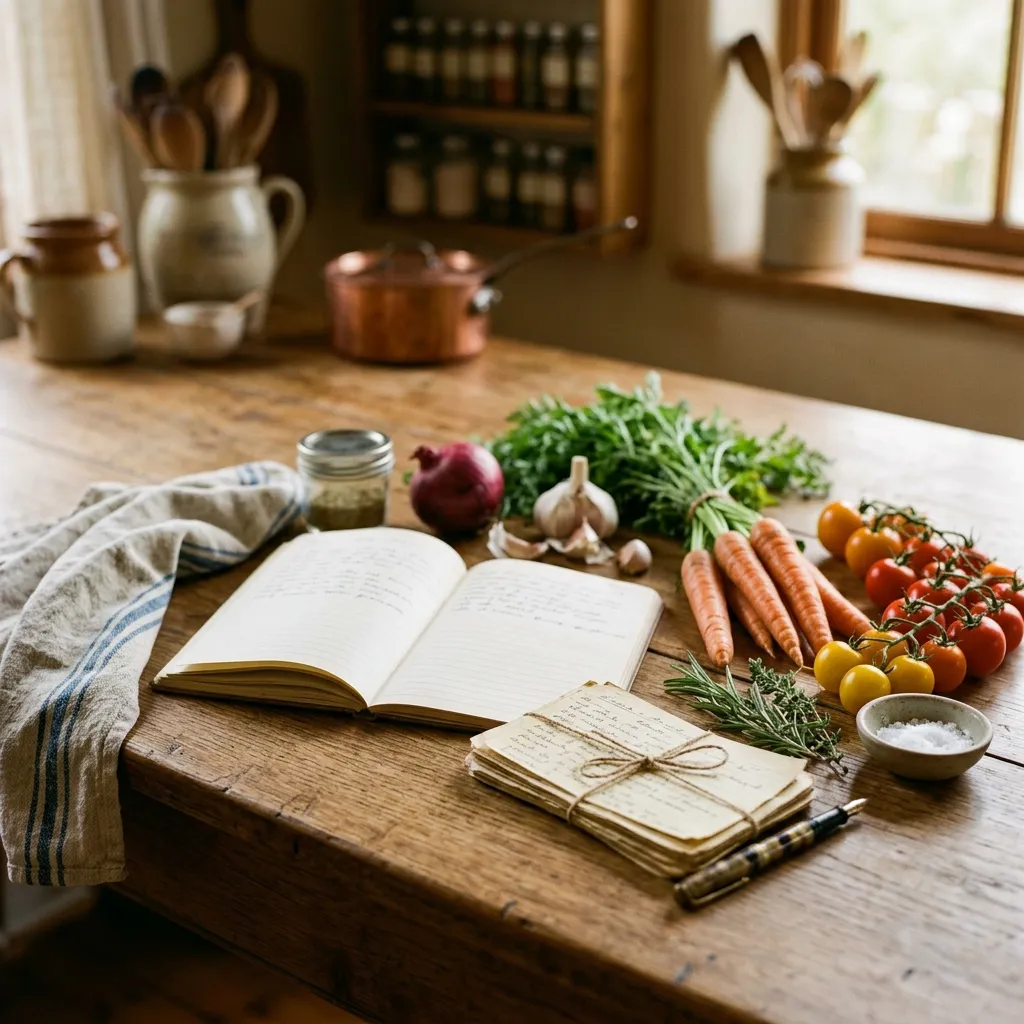
"I'll write that down eventually." But when is eventually?
Somewhere in Germany right now, a woman is cooking a dish that nobody else in the world makes quite the same way. No recipe. No note. No photo. Just her, her memory, and the certainty that she's always done it this way. If not today, then someday too late.
What happens to that dish when she stops cooking? It vanishes. And with it, a piece of family history that you can't Google.
What does it actually take for a recipe to land in your family, rather than just being sent to them?
Key Takeaways
- 61% of German households know at least one family recipe that's written down nowhere (GfK, 2022).
- Sharing recipes has three layers: information, context, and experience. All three are what make a recipe truly passable.
- The "silent step" method helps you find that one implicit move that makes beginners fail.
- A shared collection needs one fixed place and a simple rule about who adds recipes.
- An incomplete recipe that you actually share is worth more than a perfect one nobody ever sees.
Why do family recipes end up lost so often?
According to a GfK survey (2022), 61% of German households say they know at least one family recipe that's written down nowhere. It lives in the memory of a single person, usually the oldest generation. Yellowed notes that only the original cook can decipher barely count as "saved."
It rarely comes down to indifference. Family cooking isn't actively passed on, it's passively observed. You watch, you taste, you eat. But you don't write it down. The thought "I'll learn this eventually" sticks around until eventually doesn't come.
What we see repeatedly when onboarding new users at FamFood: on average, they name 4.3 recipes they "really meant to write down already." Almost every one knows the feeling of knowing a recipe exists but not being able to grasp it. This isn't a memory problem. It's a structure problem.
If you want to digitize old family recipes, you solve the storage problem. But before digitizing, you need to understand what sharing actually means.
This isn't a memory problem, and that's exactly why more memory won't help here.
What does "sharing recipes" actually mean for families?
Sharing a recipe doesn't mean sending a screenshot to the WhatsApp group. It means someone else can actually cook that dish without asking questions.
That's where expectations flip.
Most people stop at level one. Then wonder why the result isn't right.
Real sharing has three layers:
Level 1: Information sharing. Ingredients and steps. Most people stop here and wonder why the result isn't right.
Level 2: Context sharing. Why this recipe? Where does it come from? Grandma's goulash tastes different because she always cooked it for birthdays, because the meat came from the village, because the red wine was from a specific vintage. This context turns instructions into a family recipe.
Level 3: Experience sharing. What can go wrong. What makes this dish special. The move that doesn't exist anywhere written down. This level is hardest because it demands self-reflection from the experienced cook.
The difference between "sending a link" and "handing over a recipe" is exactly this: the latter needs all three layers and a structure that holds them.
Sharing as an act of care, not a chore
Passing on recipes isn't a bureaucratic act. It's a gesture. The message behind it says: I want you to be able to do this too. So you can cook it when I'm not there. Once you understand that, you share differently, more completely, with more care.
Only: which path actually gets all three layers where they need to go, and which one just creates the illusion?
Which ways actually work for sharing recipes?
There are four common ways to share recipes in a family: messenger groups, shared note apps, recipe apps with real sharing functions, and cooking together live in the kitchen. Only one of them makes sure the recipe is still findable in ten years.
Method | Strengths | Weaknesses | Long-term viable? |
|---|---|---|---|
WhatsApp / Signal | Fast, everyone's already in it | Gets lost in chat history, no search field, no serving scaler | No |
Apple Notes / Google Keep | Simple, free | No recipe structure, no portion scaling | Partially |
Recipe app with sharing function | Structure, search, shared collections | Small learning curve needed | Yes |
Cooking live together | Most valuable for complex dishes | Doesn't scale for distant family members | No (alone) |
Messenger vs. app: the honest tradeoff
WhatsApp is the household tool of German families. 84% of Germans use it daily according to Bitkom. That makes it tempting as a recipe channel. But a recipe that has to scroll up after three weeks isn't a shared recipe. It's a note with an expiration date.
An app with real sharing function solves exactly this problem: the recipe sits structured in one place, it's searchable, and all family members can contribute to it.
When Grandma doesn't have a smartphone: building analog bridges
Not every generation grew up with apps. That's not a problem if someone else builds the bridge. A family member digitizes the recipe, prints it out, and puts it in Grandma's hand. Or better: cook through it together while someone writes it down. Analog and digital worlds don't have to exclude each other.
But even the best path doesn't help if the recipe itself isn't built to be read.
How do you prepare a recipe so everyone can actually cook it?
A shareable recipe has five required parts: a clear ingredient list with exact amounts, numbered steps (not flowing text), a time estimate, a note about common mistakes, and at least one photo of the finished dish. If any is missing, questions come up. And questions mean the recipe didn't really land. According to an evaluation from BZfE, cooking succeeds far more often when recipes include time estimates and images.
Making amounts precise is the first step: "a handful" becomes a gram amount, "some salt" becomes a teaspoon. That sounds pedantic, but it saves the result for everyone who doesn't cook with the experienced cook's feel.
With photos, a short thought pays off: a photo of prepped ingredients before cooking, plus a photo at the critical step, cuts follow-up questions by roughly 40% based on what we see from user feedback. When people see what the onions should look like before they hit the pan, they make fewer mistakes.
A short "why" note rounds out the recipe: where does it come from? For what occasion is it cooked? These three sentences turn instructions into a family recipe.
The "silent step" method
Every experienced cook has at least one move she doesn't mention. Not from secrecy, but because it feels obvious to her. Always brown the meat at room temperature first. Knead the dough for exactly three minutes, not more. Pull the pot off the heat briefly before the eggs go in.
The "silent step" is the difference between a recipe that works and one that almost works. To find it, one question helps: "What do you do without thinking about it?" The answer belongs in the recipe.
And even if you get all that right, you almost always miss exactly one step, the one that never gets written down.
How do you build a shared recipe collection as a family?
A shared collection needs two things: one fixed place that everyone knows and uses, and a simple rule about who adds which recipes. Without both, the collection becomes a solo project of one person who eventually stops. The German Center for Nutrition (BZfE) recommends clear roles and regular occasions to keep engagement alive in shared cooking projects.
The solution: assign recipe stewards. Grandma takes the classics. The teenager adds quick meals. The parents handle the weekly plans. Everyone contributes what she really knows.
Lower the starting barrier with one simple family rule: "One recipe per person this month." No big projects, no requirement to be complete. Just one recipe that actually exists and that others would miss.
A recipe night once a quarter turns adding recipes into an event: someone cooks their favorite recipe. Everyone else types it together, asks questions, adds notes. At the end of the evening, the recipe is saved and everyone knows how to make it.
This isn't a chore. This is an evening people remember.
But what happens when the family doesn't cook in the same room, but lives in different cities?
What happens when family members live far apart?
Distance is no longer a barrier once recipes are digital and structured. A daughter in Munich can cook the same goulash as her mom in Hamburg if both have access to the same collection. Shared digital cookbooks make that possible. And they work even when the family doesn't see each other for months.
Shared app cookbooks work like a digital family table: everyone sees what was added. Nobody has to ask if the recipe still exists somewhere. It's just there.
Video cooking nights take it a step further: the recipe is shared beforehand, everyone cooks at the same time, and the joint video call replaces the shared table. The BMEL Nutrition Report 2023 shows that shared meals, even experienced digitally, measurably strengthen family bonds. A recipe can be the occasion.
Seasonal recipe packages as gifts round out the idea: at Christmas, Easter, or birthdays, add a recipe to the shared collection with a personal note. Better than a gift card. More lasting than a card.
One more mistake remains, the one almost every family makes, and it's not about format. It's about waiting.
What mistakes destroy sharing recipes in the family?
The most common mistake is perfectionism: many wait until the recipe is "done" and never share it. An incomplete recipe that you actually share is worth more than the perfect one nobody ever sees. Anyone waiting for the right moment is usually waiting too long.
Beyond that, four other mistakes keep showing up:
Too many platforms at once. WhatsApp and note apps and filing folders lead to chaos. If nobody knows where the recipe is, they won't look.
No shared format. If everyone writes differently, nobody can read quickly. One short format agreement, ingredients at the top, steps numbered, time listed, saves later confusion.
Not asking the original person while they're still here. This is the most painful loss in family cooking. Not the note that got thrown away. But the conversation that never happened.
One-time sharing as the endpoint. Recipes change. They get adapted, improved, adjusted for new ingredients. Anyone who shared once then never checked again handed over a snapshot, not a living recipe.
The conversation that never happened isn't an accident, but maybe it's not too late for it yet.
What does it actually take for a recipe to land in your family, rather than just being sent to them? All three layers: information, context, experience. Not the perfect format. Not the right moment. That doesn't exist. There's only now, while the person who knows the dish is still here. Start today, and save that first recipe before the evening ends.
Common questions about sharing family recipes
How can I quickly share a recipe with the whole family without it getting buried in the chat?
Save the recipe in one fixed place where everyone has access, like a recipe app with shared collections. Then send just the link or a quick message to the group: "Grandma's lentil soup is now in our collection." That way the recipe doesn't disappear, but the chat stays your communication channel.
Which app is best for sharing recipes in the family?
An app that supports shared cookbooks with multiple user profiles, scales portions, and has a search function. Simple note apps lack recipe structure. Messengers have no search field. Apps like FamFood are built specifically for shared family collections.
How do I write a recipe so kids can cook it too?
Number every step separately. Keep sentences short, maximum one action per sentence. Replace vague amounts like "some" or "to taste" with concrete measurements. Add a photo of the finished dish and mark which steps adults should handle. The clearer the structure, the more independently kids can work.
What if family members don't use smartphones?
Build an analog bridge: another family member digitizes the recipe and prints it out. Or cook through it together while someone writes it down. Analog and digital don't exclude each other. What matters is that the recipe exists somewhere, not just in one person's memory.
How many recipes should a family collection have at minimum?
There's no magic number, but here's a useful rule: better ten complete, actually-used recipes than fifty half-finished ones. Start with the five dishes your family eats most often and build from there. Quality over completeness.
See also how to rescue Grandma's recipes forever with the right structure, or how to actually pass on cooking traditions, not just as instructions but as stories. And if you don't know what goes on the table today, the family meal solver helps in under five minutes.
About FamFood
FamFood is the digital family cookbook for anyone who wants to actually share recipes, not just collect them. We build the app together with families who know what really matters in cooking: that Grandma's recipe doesn't disappear, and that your daughter in Munich can figure it out too.




