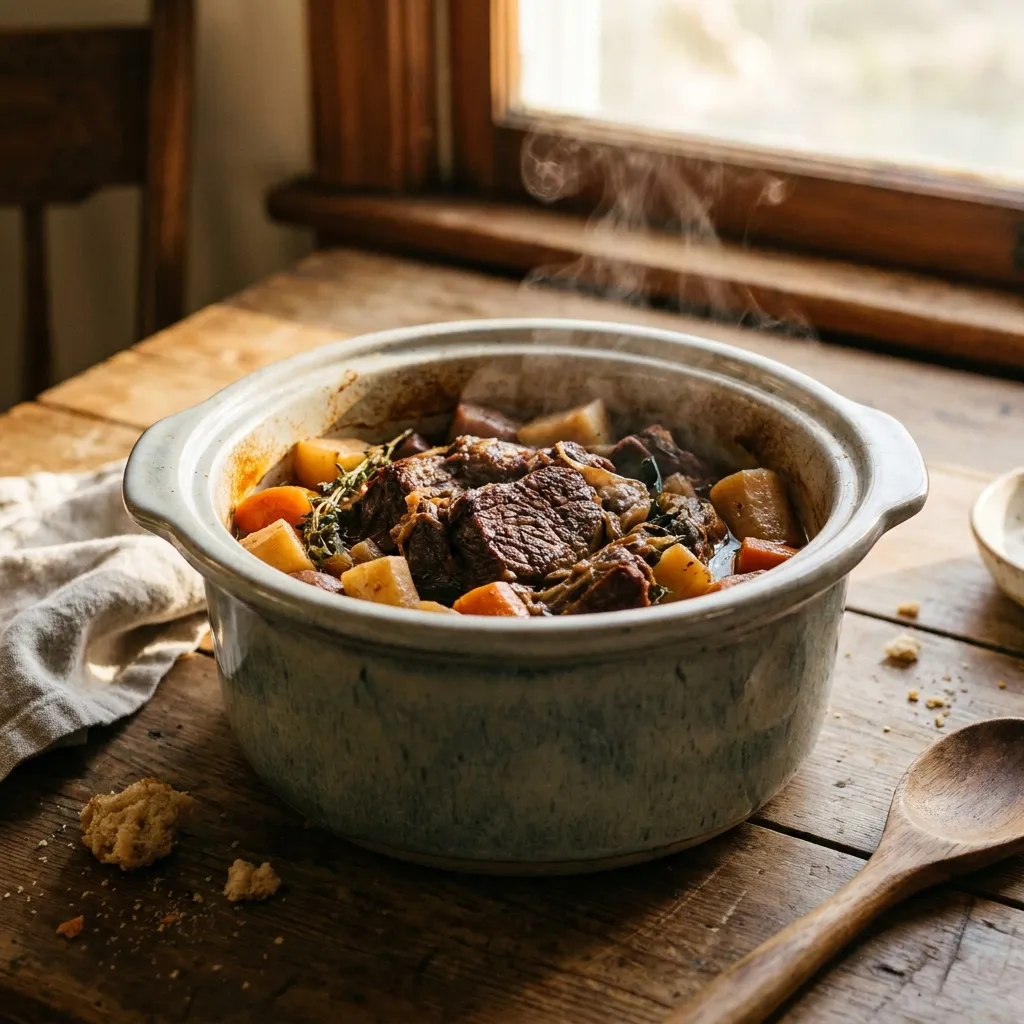
Slow Cooker Family Meals: Recipes, Sizes, Tips
Set a pot roast at 7 a.m. and dinner's ready at 6 p.m. No stirring, no checking, no burned pots while you're driving kids to school. It sounds unlikely, but that's exactly what a slow cooker delivers when you know how to use it.
No stirring. No checking on it. No pot burning while you're driving the kids to school.
The essentials
- A slow cooker cooks at 70-100 °C for 4-10 hours without supervision and costs about 23 cents per meal in electricity (BDEW, 2024 electricity price survey).
- A family of four needs at least 4.5 liters of capacity.
- Most reliable dishes: pulled pork, goulash, chicken soup, lentil stew, and tomato-paprika chicken, all with less than 15 minutes prep.
- Most common mistake: adding too much liquid. Almost no water evaporates in a slow cooker.
What does a slow cooker actually give your family?
A slow cooker cooks food at 70-100 °C for 4-10 hours with almost no supervision. Families save active cooking time because the appliance needs no stirring, turning, or checking. Dinner lands on the table finished when evening arrives. Once you cook this way, you quickly wonder why you didn't start sooner.
The method is called low-temperature cooking: instead of intense heat, gentle, even warmth works over a long period. This is exactly why cheaper cuts like shoulder, shank, or neck benefit so much. Connective tissue slowly breaks down, meat becomes tender and juicy. A pressure cooker delivers results faster, but the pressure creates a different texture. If you leave at 7 a.m. and return at 6 p.m., the slow cooker is the right partner.
In FamFood tests we see it repeatedly: simplicity wins. Of the ten most-saved slow cooker recipes on the platform, nine contain fewer than ten ingredients. Complex recipes get saved often but cooked rarely. It's not chance, but a pattern that runs through family life: when you're rushed in the morning, you grab the five-ingredient recipe, not the twelve-page cooking project. That's why this article focuses consistently on efficiency.
What size slow cooker does your family need?
A four-person family needs 4.5 to 5.5 liters. The rule of thumb is simple: 1 liter per person plus 1 liter reserve, because the ceramic insert should never be completely full. Under 3.5 liters works for couples; above 6 liters only makes sense for five or more people or if you cook for several days at once. The right size prevents buyer's remorse and frustration.
The reserve isn't optional. If the ceramic insert is too full, liquid simmers over the edge and cooking time becomes unpredictable. So if you're planning for four people, don't buy a 3-liter model even if it looks cheaper.
Household Size | Recommended Volume | Typical Use |
|---|---|---|
1-2 people | 1.5 – 3.5 liters | Soups, side dishes, desserts |
3-4 people | 4.5 – 5.5 liters | Braised dishes, stews, leftovers for next day |
5+ people | 6.0 – 7.5 liters | Large roasts, meal prep for the week |
Round or oval: shape matters
Round ceramic inserts distribute heat more evenly and work well for soups and stews. Oval models fit a whole roast or chicken without the meat being squeezed. If you plan to make both, choose oval. It's more versatile.
Electricity costs compared
Many family blogs don't actually do the math here. The results are surprising:
Appliance | Power | Runtime | Consumption | Cost at €0.32/kWh |
|---|---|---|---|---|
Slow Cooker (Low) | 90 watts | 8 hours | 0.72 kWh | about €0.23 |
Oven (180 °C) | 2,000 watts | 2.5 hours | 5.00 kWh | about €1.60 |
Stovetop (large) | 1,500 watts | 1.5 hours | 2.25 kWh | about €0.72 |
Based on average German electricity price 2024 from BDEW electricity price analysis at €0.32/kWh. The slow cooker costs about one seventh of the oven per meal. Stiftung Warentest confirms in its appliance comparisons that slow cookers are among the most energy-efficient kitchen devices available, especially for long cooking times.
Which 5 slow cooker recipes work best for families?
The most reliable results come from dishes with high connective tissue or plenty of liquid. Pulled pork, goulash, chicken soup, lentil stew, and tomato-paprika chicken are the five classics that always work in families. All five need less than 15 minutes prep and no attention in between. In the morning, out at night.
The logic is always the same: ingredients in the morning, done at night. Quantities are for four people, with enough leftovers for a second meal. For elementary school kids: reduce chili flakes, paprika, and pepper. Most children handle mild spices well, hot ones less so.
Two tips that really matter: dairy products like cream or cheese belong in only the last 20 minutes, otherwise they curdle. Fresh herbs also go in at the end, otherwise they lose color and aroma completely.
Recipe | Prep Time | Cook Time (Low) | Kid-Friendly | Leftover-Friendly |
|---|---|---|---|---|
Pulled Pork | 10 min. | 8-10 hrs. | Yes (adjust spices) | Very good |
Goulash | 15 min. | 7-8 hrs. | Yes | Good |
Chicken Soup | 10 min. | 6-7 hrs. | Yes | Very good |
Lentil-Vegetable Stew | 10 min. | 6-8 hrs. | Yes | Good |
Tomato-Paprika Chicken | 10 min. | 5-6 hrs. | Yes (mild spices) | Good |
Pulled pork for the whole week
Place 500-600 g pork shoulder (in one piece) in the ceramic insert. Add 150 ml apple juice or broth, a pinch of caraway, salt, pepper. Set to Low. After 8-10 hours, the meat shreds apart with two forks. Serve with rolls, mashed potatoes, or wraps. Leftovers make pasta sauce the next day or school lunch sandwiches. One batch, two meals.
Lentil-vegetable stew without effort
200 g red lentils (no soaking needed), 2 diced carrots, 1 onion, 1 can of tomatoes, 700 ml vegetable broth, cumin. Everything in, cook 6-8 hours on Low. The stew thickens on its own because red lentils break down as they cook. Add fresh parsley just before serving.
How do you plan slow cooker meals into your week?
The biggest lever is prep the night before: chop vegetables, season meat, put everything in the ceramic container, and refrigerate. In the morning, all you need to do is turn it on. That cuts morning effort to under two minutes.
Two weekdays work especially well: Monday and Thursday. Monday sets the tone after the weekend when energy is high and you're thinking ahead for the week. Thursday bridges the last workday before Friday, when fridge supplies run low. On these two days you can start a pot roast or stew whose leftovers cover the next day's meal.
It's called a leftovers strategy, and it works: one slow cooker meal, two dinners. Find more in Creative leftover ideas for families.
If you want to plan recipes for the week in advance, you can save them in FamFood and share them with the family. Saved slow cooker favorites can be organized into their own list so Monday mornings need no discussion. A complete weekly structure with slow cooker meals is available there under "Easy weeknight recipes: 5-day plan".
What mistakes do families make with slow cookers most often?
The most common mistake is too much liquid. Almost no water evaporates in a slow cooker, so often half the usual amount is enough. Ignore this and you get stew instead of braised meat, sometimes something that tastes more like boiled vegetables than a real dish.
Mistake number two: lifting the lid. Every time you open it adds 20 to 30 minutes to cooking time because the built-up steam escapes and interior temperature drops. Opening once near the end to stir in cream or herbs is fine. Opening three times because you're impatient costs half an hour.
With meat: filet and chicken breast get dry in a slow cooker. Shoulder, leg, and neck become tender. It's not coincidence, it's connective tissue chemistry. Expensive, lean cuts have no place in a slow cooker.
Frozen vegetables work straight in, but noticeably change cooking time upward. Better to thaw them, or add frozen pieces only in the last hour.
Finally, a safety note many miss: never place a slow cooker on wood, carpet, or plastic mats. The German Federal Institute for Risk Assessment (BfR) recommends heat-resistant surfaces and adequate distance from flammable materials.
Slow cookers and thrift: is the purchase worth it?
A slow cooker runs 8 hours at 90 watts and uses about 0.72 kWh. At an average German electricity price of €0.32/kWh according to BDEW electricity price analysis (2024), that's about 23 cents per meal. The oven often costs three times as much for the same dish. Switch to slow cooker cooking twice a week and you save over 140 euros per year in energy costs alone.
Add the shopping benefit: cheap cuts like pork shoulder or beef shank often cost half what filet or roast costs, but long cooking makes them more flavorful and tender. The slow cooker makes budget-friendly food good.
Cost Comparison | Slow Cooker | Oven |
|---|---|---|
Energy cost per meal | about €0.23 | about €1.60 |
Suitable meat | Shoulder, shank, neck | Filet, roast, chops |
Meat price (approx.) | €5-8/kg | €12-25/kg |
Attention needed | None | Regular |
Entry-level models start at 30 to 60 euros. If you cook twice a week and save about 1.40 euros compared to the oven, the device pays for itself in about two months.
Kids and slow cookers: how do you get them on board?
Children find slow cookers fascinating. The appliance works quietly all day and serves finished dinner that smells like hours of work. You can deliberately stage this moment, and it's worth it.
Let them help loading it in the morning. Put in carrots, measure broth, set the lid. It takes three minutes and creates something that lasts all day: anticipation. When you sit at the table that evening and can say "I helped cook this this morning," you eat with a different attitude.
Visually kid-friendly dishes are soft, mild, and without large pieces that scare them away. Pulled pork in rolls, creamy lentil soup, tender chicken in tomato sauce. Anything that shreds easily goes over well.
And if you want to make the recipes a family ritual: in FamFood you can save favorite recipes together and bookmark them for next week with one click. Your digital cookbook grows with your family.
Frequently asked slow cooker questions
Can I run my slow cooker overnight?
Yes, you can if the appliance sits on a heat-resistant, fireproof surface and the lid fits properly. Many families start the slow cooker on Low in the evening so the meal is ready in the morning. Manufacturers and the BfR recommend never running the appliance unattended on flammable surfaces. For overnight use: use a stone tile or ceramic tile as the base.
What foods should I never put in a slow cooker?
Dairy products like cream, yogurt, or cheese belong in only the last 20-30 minutes or they curdle. Fresh herbs lose color and aroma completely with long cooking, so always add them at the end. Raw kidney beans must be cooked at least 10 minutes before adding because raw they contain a toxin that low temperatures don't destroy. Red lentils and green or brown lentils are safe without precooking.
How long does chicken leg take in a slow cooker?
A chicken leg takes about 5-6 hours on Low, or 3-4 hours on High. The meat is done when it pulls easily from the bone. To be sure: check the internal temperature at 82 °C. Chicken breast is done after 3-4 hours on Low but gets dry if it stays longer. Legs and thighs forgive an extra hour without quality loss.
Do I need to brown meat before the slow cooker?
No, it's not necessary. The meat cooks through and becomes tender without browning first. But if you want roasted flavors, brown the meat hot for 2-3 minutes before it goes in the slow cooker. Especially for goulash or pot roast it's worth the step because the Maillard reaction creates flavor depth that pure braising doesn't reach. As a family weeknight shortcut you can skip it; as a Sunday dinner it's a clear win.
About FamFood
FamFood is the digital cookbook for families who love to cook but hate spending time searching for recipes. We test recipes in real family situations and know what works when three kids are waiting for dinner and the evening's already half gone. Save recipes, share them, and plan for next week: famfood.app.




