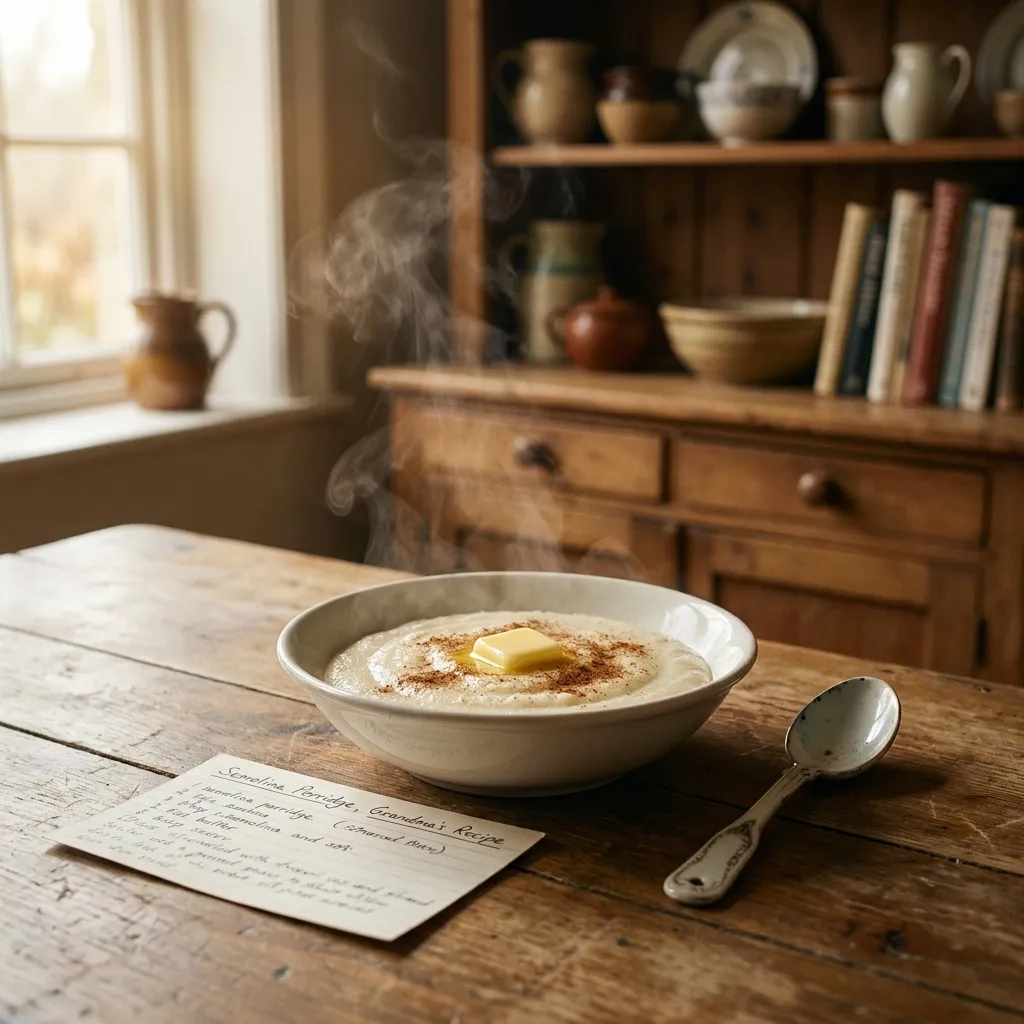
A single smell is enough. One whiff of cinnamon or freshly heated milk, and suddenly you're eight years old in Grandma's kitchen. The phenomenon is real, measurable, and it explains why some recipes must never disappear.
Key Takeaways
- Food aromas bypass the thalamus and land directly in the brain's memory and emotion centers, making them stronger than photographs.
- Childhood taste develops through repetition plus emotional context, not through special ingredients.
- According to the Federal Centre for Nutrition (BZfE), semolina porridge, lentil soup, and pancakes rank among the most common childhood dishes in Germany.
- Orally passed-down recipes disappear with every generation that passes. The best time to save them is now.
Why does a single smell suddenly unlock an entire childhood?
Smells connect directly in the brain to the hippocampus and amygdala, the centers for memory and emotion. That's why a hint of cinnamon or freshly cooked semolina triggers stronger memories than a photograph. While visual or auditory stimuli first pass through the thalamus, olfactory signals go straight to the limbic system, where feelings and memories are stored.
For our ancestors, smells were essential to survival. The brain treats them differently than other senses. Evolution, not sentimentality, explains this.
This effect is especially strong with food aromas because they're paired with intense repetition in childhood. The same kitchen every Sunday, the same pots, the same warmth. Neural patterns activated so often burn in deep. When someone reactivates these patterns years later, they don't experience a vague hint of the past—they undergo a complete sensory return.
In the FamFood team, we witness this constantly: a mother saves semolina porridge with a note: "Just like Grandma's, I've cooked it three times, the fourth time was right." That's not nostalgia, that's neuroscience in everyday life. She's not looking for a recipe; she's looking for a memory.
Grandma's recipes work emotionally differently from any new dish because they have a starting point in a time when the brain was especially receptive.
What makes a dish a true childhood taste?
True childhood taste emerges from three factors together: regular repetition, emotional context, and the absence of alternatives. This combination burns so deeply into memory that a single smell later triggers the entire memory. A dish eaten only once leaves no childhood taste, no matter how good it tasted. It needs the repeated Sunday, not the extraordinary dinner.
It's not expensive ingredients, but exactly these three factors. Someone who ate the same soup every Sunday as a child has etched that soup deep into their memory.
Ritual beats recipe
"Every Sunday" is more powerful than the best recipe. The ritual, the fixed seat at the table, the smell that drifted through the apartment even before waking up—that's the true carrier of memory. The recipe is only the vehicle. Families who regularly cook and eat together automatically create new memory anchors for their children, whether they do it consciously or not.
The nostalgia bias in the kitchen
Even dishes that objectively had little refinement are remembered positively. Nostalgia bias means the emotional environment—safety, belonging, comfort—overlays the actual taste. That's why "Grandma's cooking" almost always feels better than a neutral replay of the same dish in a stranger's kitchen. Safety tastes good.
Important to note: childhood taste isn't a universal "Grandma classic." It's always family and region-specific. Your semolina porridge isn't your best friend's semolina porridge, even if the recipe were identical.
Which dishes trigger the strongest childhood memories in German families?
According to a representative survey by the Federal Centre for Nutrition (BZfE) from 2022, semolina porridge, lentil soup, potato soup, and pancakes rank among the most frequently named childhood dishes in Germany. Regional variants like labskaus in the north or käsespätzle in the south follow close behind. What all these dishes share: inexpensive ingredients, a lingering cooking aroma, and a filling effect that reproduces the body sense of childhood.
Striking in FamFood user data (analysis of saved recipes tagged "memory" or "childhood," 2024): 8 out of 10 of these recipes contain fewer than 10 ingredients. Complexity is no guarantee of emotional depth; quite the opposite.
Region | Typical Childhood Dish | Leading Flavor |
|---|---|---|
Northern Germany | Labskaus, kale with pinkel | Hearty, savory, wintry |
Central Germany | Thuringian dumplings, mustard soup | Filling, mild, grounding |
Southern Germany / Bavaria | Käsespätzle, steamed noodles | Cheesy-warm, sweetish, soft |
Baden-Württemberg | Lentils with spätzle, maultaschen | Sour-hearty, festive |
Eastern Germany | Soljanka, semolina dumpling soup | Aromatic, clear, familiar |
Simple dishes win because they offer so little distraction. No competing aroma distracts from the leading flavor. The brain can store the pattern cleanly and retrieve it cleanly later.
How do you reconstruct a taste that's never been written down anywhere?
Grandma's recipes often exist only in her head, in gestures and amounts done "by feel." Reconstruction works best through a combination of witness interviews, iterative test cooking, and deliberately noting sensory impressions instead of quantities. This sounds labor-intensive. It's worth it.
The witness method
Don't ask older family members for gram measurements. They don't know them. Ask about sensory impressions: What did the sauce look like just before it was done? Did the porridge stick or flow? Did it smell like butter or lard? These answers are more precise than any amount because they come straight from the memory that stored the dish back then.
Write the answers verbatim. "Like melting snow" is a better consistency description than "creamy."
Iteration kitchen: cook three times, nail it once
Cook the same dish three times in short intervals. On the first run, you record everything you did. On the second run, you change one variable. On the third, you decide which version better matches the original. Only then do you standardize.
The most common mistake in reconstruction is fixing things too early. Someone who writes a "final recipe" after the first try freezes errors in place. FamFood offers note fields right in the recipe where you can capture: "just like Grandma always said" or "second try, doubled butter, too greasy." That's not chaos; that's method.
What happens if your children's taste becomes different from yours?
Each generation writes its own childhood taste. That's not a loss; it's a natural process. What matters isn't exact reproduction, but passing on the ritual around cooking. Your children may not love your lentil soup. But if they stood in the kitchen with you and stirred, they've still taken something they'll retrieve someday.
Generational taste shifts are inevitable. New ingredients, different influences, changed daily rhythms. That doesn't mean old dishes become irrelevant. It means they need new context.
A concrete step: start a family recipe book where each generation enters its own childhood dishes, with names, regions, memories. Not as a museum, but as a living document. Anyone looking back twenty years from now will find not just recipes, but family history in portions.
Digital family recipes function as both archive and conversation starter. Once the recipe is saved, a new opportunity to talk about it emerges.
How do you recreate childhood taste for today without distorting it?
Small adjustments to modern eating habits are fine, as long as the core texture and leading flavor stay true. Someone cooking semolina porridge with plant-based milk changes the recipe, not the memory. The memory clings to the creamy mouthfeel and sweet grain aroma—both survive if you use oat milk. What doesn't survive: different texture or dropping the main aroma base.
The practical 80/20 rule: 80 percent of the original stays untouched. 20 percent can evolve.
Element | You Can Adapt | Don't Touch |
|---|---|---|
Liquid | Plant-based milk, reduced fat | Amount and ratio to starch |
Fat | Butter swapped for margarine or less | Remove fat entirely |
Sweetness | Lower sugar content, alternatives | Strip sweetness from sweet dishes |
Spices | Add, vary | Remove leading spice (e.g., nutmeg in porridge) |
Texture | Finer or coarser version | Change basic consistency |
Concretely: semolina porridge with oat milk instead of whole milk, sugar halved, pinch of vanilla and nutmeg as in the original. The result hits 90 percent of the memory. Your body knows it.
Why save childhood recipes now instead of someday?
With every generation that passes, recipes that aren't written down disappear. According to Destatis, roughly 1 million people die in Germany annually. Each carries knowledge, habits, and recipes that are never documented. Family recipes, local cooking techniques, regional variants. The conversation with Grandma won't happen a second time if the moment is missed.
The right moment for the conversation isn't Christmas when everyone's busy. It's a normal Sunday afternoon with coffee and time.
You only need three things: your phone to record, 20 minutes, and the right questions. For example: What did you smell first when the dish was ready? What was the one ingredient you never replaced? When did you first cook it for someone?
Then open FamFood and save it before the day ends. Not someday.
Frequently Asked Questions
Why does food always taste better at Grandma's than at home?
The difference rarely lies in the recipe. Grandma's kitchen connects to safety, belonging, and relaxation. These emotions literally change how the brain processes taste. Someone who eats relaxed tastes more. Someone who feels safe rates food more positively. That's not imagination; it's neuroscience.
Can you really recreate childhood taste one-to-one?
Rarely, and that's okay. Memory itself changes over time and idealizes the original. A 90-percent match, where core texture and leading flavor align, is enough to trigger the emotional effect. Perfect reproduction isn't a realistic goal; approximate fidelity is.
What if Grandma no longer remembers the recipe exactly?
Use the witness method: ask about sensory impressions instead of quantities. "What did the sauce smell like?" yields more than "How much salt?" Combine multiple family members as sources and cook the dish iteratively. After each run, note what came closer until you hit the original.
How do you explain to your kids why these old dishes matter?
Not through explanations, but through experiences. Cook the dish with them, tell them where you first ate it and why it matters to you. The ritual of cooking together creates a new memory anchor. In twenty years, they'll remember the moment, not the recipe.
Which childhood recipes adapt well to modern eating?
Grain-based dishes like semolina porridge, pancakes, or rice pudding tolerate plant-based milk alternatives well without losing leading flavor. Stews and soups can be cooked with less fat. Trickier are dishes where lard or butter carries the main taste: here the 80/20 rule applies strictly.
Save your first Grandma recipes before the moment passes. Not because you have to, but because you know what's lost if you don't.
About FamFood: We're a team of parents, home cooks, and tech people who believe family recipes are too valuable to forget. FamFood is where your kitchen gets memory—warm, personal, and ready for the next generation.




