Use Up Leftovers: 7 Creative Ideas for Families
The fridge is half empty. The clock is ticking. And throwing food away just feels wrong.
You don't need culinary training or a complete recipe. You need a system. This article shows you what creative leftover cooking looks like in a real family kitchen, which foods are wasted most often, and how to turn them into something proper in under 20 minutes.
Key Takeaways
- Every person in Germany throws away an average of 78 kg of food per year (BMEL, 2023).
- A 4-person household loses around €935 a year to food waste as a result.
- The Four-Part Formula (base, protein, flavour, binder) turns any leftover into a meal, no fixed recipe needed.
- Keeping leftovers visible and saving leftover recipes somewhere easy to reach are the two most effective habits you can build.
What does using up leftovers actually mean in a real family kitchen?
Using up leftovers doesn't mean forcing yourself through bland reheated meals. It means building something new from what's left in under 20 minutes. According to the German Federal Ministry of Food and Agriculture (BMEL), every person in Germany throws away an average of 78 kg of food per year. A large share of that waste doesn't happen in supermarkets; it happens at home.
The difference between "reheating" and "reassembling" is what matters. Yesterday's leftover pasta is boring. That same pasta with an egg, a bit of cheese, and some fresh parsley becomes a frittata. Same ingredients, completely different result.
Among the recipes most frequently saved by FamFood users, leftover-cooking ideas in the soups and stir-fry categories consistently top the list. That tells us families aren't looking for gourmet leftover solutions; they want fast, reliable ideas for the exact moment the fridge is nearly empty.
Which foods end up wasted most often?
Bread, potatoes, vegetable scraps, and cooked meat make up the lion's share. According to WWF Germany's study "The Big Throwaway", bread and baked goods together with vegetables are the most common food waste categories in German private households. Neither category lacks good intentions; what's missing is a concrete idea.
Category | Why does it get thrown out? | Rescue potential |
|---|---|---|
Bread & baked goods | Bought too much, unclear shelf life | High: bake, breadcrumbs, toast |
Vegetables (incl. cavolo nero) | Wilted but still fine | High: chips, fried rice, soup |
Potatoes | Often cooked in too large a batch | High: pancakes, patties |
Meat scraps | Looks old, isn't old | Medium: frittata, salad, wrap |
Dairy products | Best-before date used as an excuse | Medium: dips, pancakes, sauces |
A real example from online conversations: in the German Reddit community r/Kochen (a popular German-language cooking forum), the question of what to do with cavolo nero when it goes limp in the fridge comes up regularly. The answer is simpler than you'd think; see Idea 3 below for the details.
Bread and baked goods: the underrated raw material
Stale bread loses moisture, but not flavour. Toasted, soaked, or crumbled, it works in almost any kitchen situation.
Vegetable scraps: what's actually still good
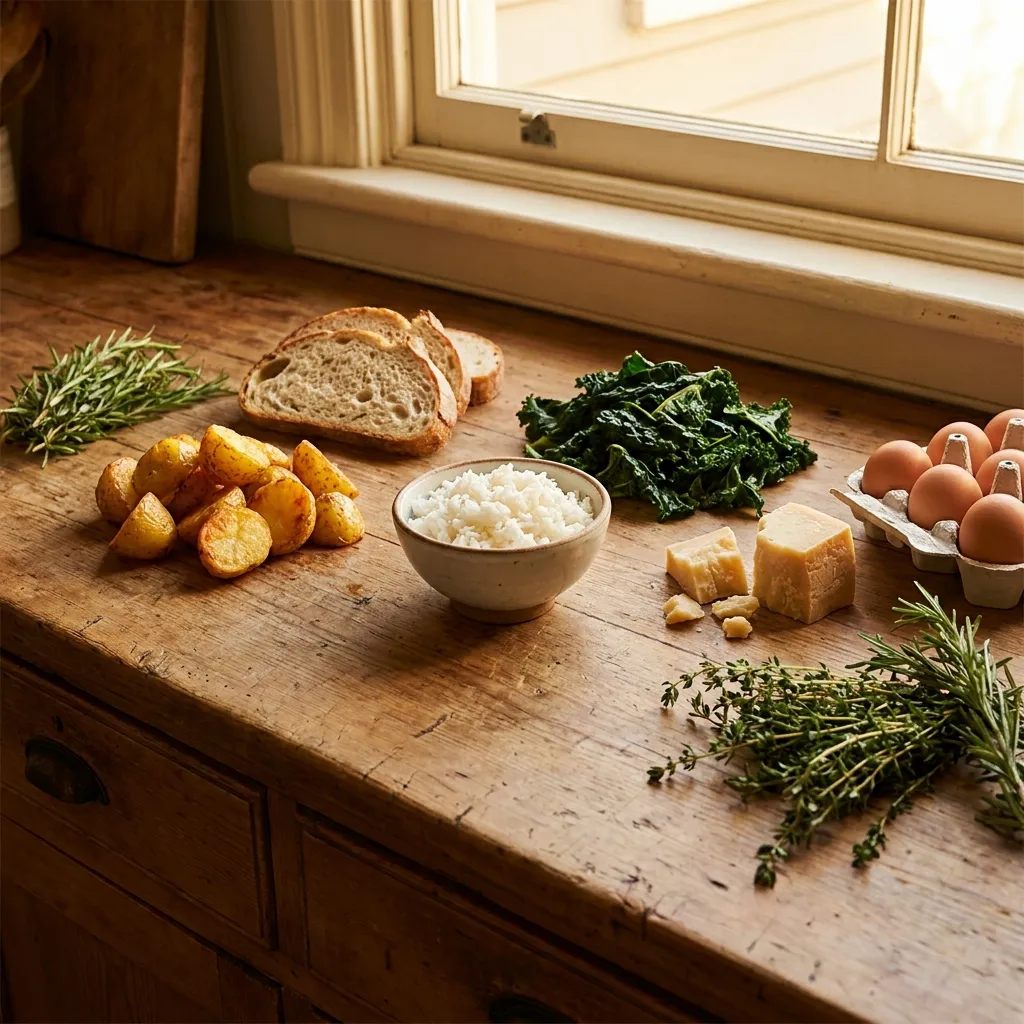
Wilted vegetables are not the same as spoiled vegetables. As long as there's no mould or off smell, they're usable. Cavolo nero, kale, and stem vegetables hold up well even when slightly limp, for stir-fries, chips, or soups.
The principle behind creative leftover cooking: how do you build a dish?
Every leftover dish follows the same pattern: a base (carbohydrate or legume), a protein component, a flavour base (onion, garlic, spice), and a binder or sauce. Once you know this Four-Part Formula, you don't need a fixed recipe. The combinations emerge naturally from whatever is waiting in the fridge.
The Four-Part Formula in practice:
- Base: rice, pasta, potatoes, bread, legumes
- Protein: egg, meat scraps, fish scraps, legumes (can also serve as the base)
- Flavour: onion, garlic, ginger, chilli, bay leaf, miso
- Binder / sauce: egg, cheese, tomato paste, stock, yoghurt, mustard
A word on seasoning: for leftover cooking, fleur de sel at the end, coarse sea salt during cooking, and smoked salt for meat scraps that need a little depth. How you season at the end matters more than the recipe itself.
In FamFood tests, we've seen that families with a dedicated leftover recipe collection throw food away 2 to 3 times less per week than those without one; simply because they know which basic combination is waiting for them in the fridge.
One more tip for air-fryer fans: leftover potato dumplings, rice patties, or vegetable balls come out perfectly crispy again in an air fryer at 180 °C (350 °F) in 10 minutes. No oil, no fuss.
Which 7 ideas turn typical leftovers into a proper meal?
Seven ideas, one principle: each row shows what goes in and what comes out. No fine dining, no long ingredient lists.
# | Leftovers | Dish | Time |
|---|---|---|---|
1 | Cooked potatoes + quark | Potato-quark pancakes | 15 min. |
2 | Stale bread | Bread bake or panzanella | 20 min. |
3 | Wilted cavolo nero | Cavolo nero chips or cavolo nero fried rice | 15 min. |
4 | Pickled herring scraps | Herring salad toast | 10 min. |
5 | Vegetable and meat scraps | Frittata or omelette | 15 min. |
6 | Root vegetables + grains | Quick stew | 25 min. |
7 | Rice + potato scraps | Air-fryer patties | 20 min. |
Leftovers from the fridge (raw or cooked)
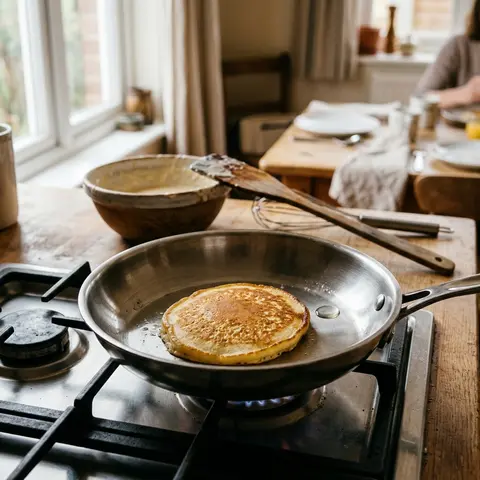
Potato-quark pancakes: Roughly mash cooked potatoes, mix with quark (a fresh German soft cheese, similar to fromage frais), one egg, salt, and a little flour. Fry small patties in the pan. The potato-and-quark combination sounds unremarkable, but it's filling and needs almost no additional ingredients.
Frittata: Roughly chop all vegetable and meat scraps, sauté in an oven-safe pan, pour over beaten eggs, scatter cheese on top, and bake at 180 °C (350 °F) for 12 minutes. Works every time.
Cavolo nero fried rice: Roughly chop the cavolo nero leaves and fry with cold rice, a little soy sauce, ginger, and one egg. Wilted leaves become surprisingly aromatic when fried. It's a combination the r/Kochen community hasn't collectively discovered yet, but it works really well.
Leftovers from bread and baked goods
Bread bake: Slice stale bread, soak in an egg-and-milk mixture, layer in a baking dish, top with cheese or tomatoes, and bake for 25 minutes. Sweet version: with cinnamon, egg, and a little honey as a breakfast bake.
Panzanella: Cube and toast old bread, then toss with tomatoes, basil, red onion, olive oil, and a splash of vinegar. Leave to sit for 15 minutes. Done.
Leftovers from meat and fish
Herring salad toast: Pickled herring is one of the most intensely flavoured fish there is; which is exactly why you don't have to eat it plain. Finely chopped with sour cream, diced apple, and fresh dill on toasted rye bread, the strong flavour is softened and the result is bold yet fresh.
How do you organise your leftovers so you actually use them?
The most common reason leftovers get thrown away isn't laziness. You simply forget they're there. One simple rule and saving leftover recipes in a dedicated list solve the problem for most families for good.
The front-of-fridge trick: Leftovers always go at eye level in the fridge, never behind fresh ingredients. What you see, you use. What stays hidden, goes mouldy.
Keep leftover recipes in one central place: In a stressful moment, when the fridge is half empty and the kids are hungry, nobody has time to Google. If your favourite leftover ideas are saved in a collection you can reach instantly, you'll use them instead of ordering takeaway or throwing food away.
With FamFood you can do exactly that: create your own leftovers collection, save recipes with a single tap, and sort them so that the next time the fridge is nearly empty, you know immediately what's possible.
What can you freeze, and what's better left out?
Freezing significantly extends the window for using most leftovers. The exceptions: raw potatoes, dishes thickened with cornstarch, and anything with a high egg content lose texture and flavour considerably.
Food | Freeze? | Why |
|---|---|---|
Soups and stews | Yes | Keeps for 3 months, thaws quickly |
Bread and rolls | Yes | Quality stays almost entirely intact |
Cooked rice | Yes | Freeze in portions, straight from the freezer into the pan |
Cooked meat scraps | Yes | Up to 2 months; label clearly |
Raw potatoes | No | Turn watery and mealy |
Creamy sauces | No | Split when thawing |
Hard-boiled eggs | No | Rubbery whites after thawing |
Cheese (grated) | Yes | Use straight from frozen for gratins |
One non-negotiable: label everything. Date and contents; otherwise it ends up in the bin anyway because nobody can remember what's in the bag. Small effort, big impact.
Does creative leftover cooking actually pay off financially?
Yes, and the numbers are clearer than most people expect. The German Federal Environment Agency (Umweltbundesamt) estimates that a 4-person household loses around €935 a year to food waste. That's not an abstract figure. It's close to €80 a month that you're not spending; you're literally throwing it in the bin.
Anyone who consistently uses up leftovers 2 to 3 times a week instead of buying new ingredients will feel that amount drop noticeably. No major lifestyle overhaul needed, no dietary philosophy required. Just a system and the right ideas within easy reach.
In the end, it's not about being frugal out of obligation. It's about the feeling of not having wasted anything. And about the food you bought actually being eaten, by your family, at your table.
Frequently asked questions about leftover cooking
How long are leftovers still good in the fridge?
Cooked dishes typically keep for 2 to 3 days at below 5 °C (41 °F). Fish and seafood should be used within 24 hours. Raw vegetables and bread are often good for 4 to 5 days. According to the German Nutrition Center (BZfE), a smell and visual check is more reliable than the best-before date on the packaging: colour, smell, and texture tell you whether a dish is still safe to eat.
Can I freeze cooked rice and use it later?
Yes, cooked rice freezes very well. Freeze it in shallow portions so it cools through quickly. Add it directly from the freezer into a hot pan with a little oil and fry on high heat. This actually produces more flavourful fried rice than freshly cooked rice does.
What can I make with stale bread besides breadcrumbs?
More than you'd think. Bread bake, panzanella, toasted croutons for salad, marinated bread chips with olive oil and rosemary, sweet bread pudding with egg and milk, or simply cut into cubes and floated in soup. You'll find the complete bread guide for families in the FamFood collection.
Which seasonings rescue a bland leftover dish fastest?
Smoked paprika adds depth instantly. Soy sauce or miso bring umami without much effort. Fresh lemon juice or vinegar lifts heavy dishes. Toasted cumin gives legumes and potatoes real character. These four ingredients cost little, keep for a long time, and rescue almost any bland leftover dish.
How do I get kids on board with eating leftovers without complaints?
Don't explain it; reframe it. Don't call it "leftovers"; call it "yesterday's secret recipe" or "experiment kitchen." Let the kids have a say in what gets made from the ingredients. Whoever helped build the dish usually eats it. This works reliably from around age 4. We've watched it play out with several families in FamFood tests.
About FamFood: We're building an app for families who love cooking but have little time. FamFood helps you save recipes, collect ideas, and organise your daily kitchen life without paper chaos and without endless Googling. Made by a team that cooks itself and knows exactly what a full fridge looks like on a Monday evening.