Vegetarian Family Cooking: Make It Work
Most people think the same thing in that moment: The child's just going through a phase, it will pass.
It usually happens at dinner. The child puts down the fork, glances at the plate, then around the table, and says: "I'm not eating meat anymore." The kitchen goes quiet. A short exhale. Another child asks if they can have the schnitzel.
Right then, in those two minutes, everything gets decided: whether the next few weeks will be relaxed or tense, and whether the child's wish gets respected or dismissed. How do you respond when a child suddenly stops eating meat, and how do you cook for a family that's no longer the same?
Key Takeaways
- Children aged 8–14 reject meat more often for ethical reasons than taste. That's developmental psychology, not defiance.
- Well-planned vegetarian diets are nutritionally sound for children according to the German Nutrition Society (DGE), provided iron, B12, zinc, and calcium are covered.
- The three-column building block principle (protein + filling side + vegetables) makes 80% of vegetarian family meals plannable without a recipe book.
- Among the most-saved vegetarian recipes in FamFood, 6 out of 10 feature legumes as the main protein.
What's Really Behind the Desire to Stop Eating Meat?
Children aged 8–14 reject meat more often for ethical reasons than taste, according to a German Federal Center for Nutrition (BZfE) study from 2022.
Behind the sentence "I'm not eating meat anymore" is usually no tantrum at all.
Usually there's a first moral stand. That's developmental psychology.
The most common triggers FamFood users report: a school project on factory farming, a video on YouTube or TikTok, a friend who's already vegetarian, or a visit to a farm where the child first understands where meat comes from. These moments are rarely fleeting.
Still, it's worth listening first before restructuring the meal plan. Ask: Why exactly? Since when? What's the goal? Not to discourage the child, but to understand whether this is a brief phase or real commitment. A child who can explain their reasons will stick with the change.
What doesn't help: dismissing the concern, saying "it will pass," or immediately countering with nutrition facts. What helps: try it together for a week or two and see what develops.
Whether the commitment holds becomes clear only when the next question comes—and it's less comfortable than it sounds.
Is Vegetarian Diet Really Safe for Kids?
Yes. Well-planned vegetarian diets are nutritionally sound for children and adolescents. The German Nutrition Society (DGE) considers them acceptable with sufficient intake of iron, zinc, vitamin B12, and calcium. These four nutrients are what most often fall short in unbalanced vegetarian diets. What "well-planned" means concretely: rotating protein sources daily, dairy products or eggs as B12 sources, and leafy greens combined with vitamin C for better iron absorption. A diet that knows only pasta and cheese won't meet these needs, no matter how good the intentions.
Which Nutrients Are Most Likely to Be Missing?
The gaps rarely appear all at once. They creep in when variety vanishes. These five nutrients deserve regular attention:
Nutrient | Why Critical for Kids | Foods That Help |
|---|---|---|
Iron | Growth, concentration, energy | Lentils, oats, pumpkin seeds, spinach + vitamin C |
Zinc | Immune system, wound healing | Cheese, legumes, whole grain bread, nuts |
Vitamin B12 | Nervous system, found only in animal products | Eggs, dairy products, fortified foods |
Calcium | Bone development, especially during school years | Milk, yogurt, sesame, broccoli, mineral water |
Iodine | Thyroid function | Dairy products, iodized salt, sea vegetables (moderate) |
When Is Diet Enough? When Do You Need Supplements?
For lacto-ovo-vegetarian children (children who still eat dairy and eggs), a varied diet is usually sufficient. B12 is the only nutrient that comes almost exclusively from animal foods. Kids who eat eggs and dairy regularly are typically well covered.
A doctor's visit or brief nutrition consultation is worth it if the child is very picky, growing fast (puberty), or showing symptoms like persistent fatigue. An annual blood test provides quick clarity here.
It's safe, but only as long as you don't fall into the trap that catches most families in the first month.
How Do You Build Meals That Actually Fill Everyone Up?
Protein plus filling side plus vegetables: this three-part principle works. Replace meat with legumes, eggs, or cheese and adjust portion sizes, and in 80% of cases you'll create a more satisfying meal than with meat. The problem isn't missing fullness—it's missing habit.
What we often see in FamFood families: the switch to vegetarian cooking fails less on taste than on missing ritual. The family has known the schnitzel-potato-salad pattern for years. A new pattern just needs a few repetitions until it feels normal. The three-column building block principle doesn't replace a recipe book, but usually makes it unnecessary: pick from column A, column B, and column C, combine, done.
Protein Sources Kids Won't Immediately Reject
Protein (Column A) | Filling Side (Column B) | Vegetables (Column C) |
|---|---|---|
Red lentils | Whole wheat pasta | Zucchini, diced |
Chickpeas (canned) | Basmati rice | Bell peppers, roasted |
Eggs (scrambled, omelet) | Baked potatoes | Broccoli, roasted |
Feta or cottage cheese | Couscous | Tomatoes, fresh |
Tofu, crispy baked | Spelt rolls | Carrots, as a dip |
Data from FamFood users shows: among the most-saved vegetarian recipes, 6 out of 10 feature legumes as the main protein. Lentils and chickpeas win because they're quick, cheap, and shapeable. They take on any flavor you give them.
Fullness Traps and How to Avoid Them
Pasta with tomato sauce isn't a meal that keeps you full. It delivers carbs but barely any protein or fat. Two hours later, the child is hungry again. The trap isn't the pasta—it's the missing column A. Stir an egg into the sauce, add lentils, or sprinkle plenty of parmesan on top. Three columns, always.
The three-part principle works, and not just from the third try either—it works the first night if you know how to start.
How Does a Realistic Week-by-Week Transition Plan Actually Work?
Anyone who switches to seven vegetarian days at once usually fails by day three. Better: establish two fixed vegetarian evenings per week until they're routine, then expand to four. This is called the 2-4-7 method, and it works because it keeps family resistance small.
Phase | Days per Week Vegetarian | Duration | Example Days |
|---|---|---|---|
Start | 2 | 2–3 weeks | Monday, Thursday |
Expand | 4 | 3–4 weeks | Mon, Tue, Thu, Fri |
Routine | 5–7 | ongoing | Per family preference |
Monday works well for lentil soup: it can be made on the weekend and tastes better reheated. Thursday suits roasted vegetables with feta because Thursday often feels tired and the oven does the work.
What matters is that the kids help plan. Not every step, but the choosing part. Ask Friday: "What do we cook next Monday?" This noticeably increases acceptance on Monday because the child remembers their own decision.
For a structured meal-planning strategy for the whole week, the FamFood app has a ready-made template you can adapt directly.
The plan is set. What remains is the toughest problem no weekly plan solves: the child who simply won't touch the vegetables.
What Do You Do When Kids Won't Eat the Vegetables?
Vegetable aversion is normal in 4–12-year-olds. What matters isn't whether the child loves broccoli—it's whether they get enough variety to meet their needs. Hiding vegetables helps short-term but doesn't develop taste long-term. The goal is a kid who at 16 buys vegetables independently, not one who'll only eat what they can't see.
The difference between "hiding" and "preparing differently" is crucial. Hiding means: puréed zucchini in the sauce without the child knowing. Preparing differently means: roasted zucchini, caramelized, with a dip, so the child notices they like it—but the zucchini is still zucchini.
Our tests also show: kids who get to arrange their own vegetables on the baking sheet eat significantly more of them. Taking responsibility at the plate lowers resistance before it.
Roasting, Baking, Dipping: The Three Preparations with the Highest Success Rate
Raw carrot nobody likes becomes a halved oven carrot with honey and thyme that suddenly disappears. Roasting makes vegetables sweeter (Maillard reaction, caramelization of natural sugars), softer, more aromatic. Baking in the oven works similarly. The dip as the third element lowers the barrier: a child who likes hummus will try the piece of pepper next to it because it becomes a vehicle for the hummus.
Repeated exposure is the often-forgotten principle. According to the BZfE, an unfamiliar food must be offered to a child 10 to 15 times before they're willing to try it. Not eating every time, not commenting every time. Just offering.
Once you know how vegetables get accepted, you need the recipes that bring it all together in real family cooking, and ones that work in under 30 minutes.
What Recipe Ideas Actually Work in the Real Family?
The best vegetarian family recipes have three things in common: under 30 minutes prep time, maximum 8 ingredients, and at least one element kids can prepare themselves. The third criterion matters most for acceptance.
Five recipes that work regularly in FamFood households:
- Chickpea Pan with Bell Pepper and Feta (20 min): Canned chickpeas browned with bell pepper strips and cumin, feta on top. Kids can crumble the feta.
- Zucchini Fritters (25 min): Grated zucchini mixed with egg, oats, and cheese, shaped into patties, baked in the oven. Kids form the patties themselves.
- Lentil Bolognese (30 min): Red lentils, tomato purée, onions, garlic. Tastes like bolognese, contains no meat. Kids stir along.
- Omelet Night (15 min): Everyone fills their own omelet. Cheese, mushrooms, tomatoes, herbs, whatever's on hand.
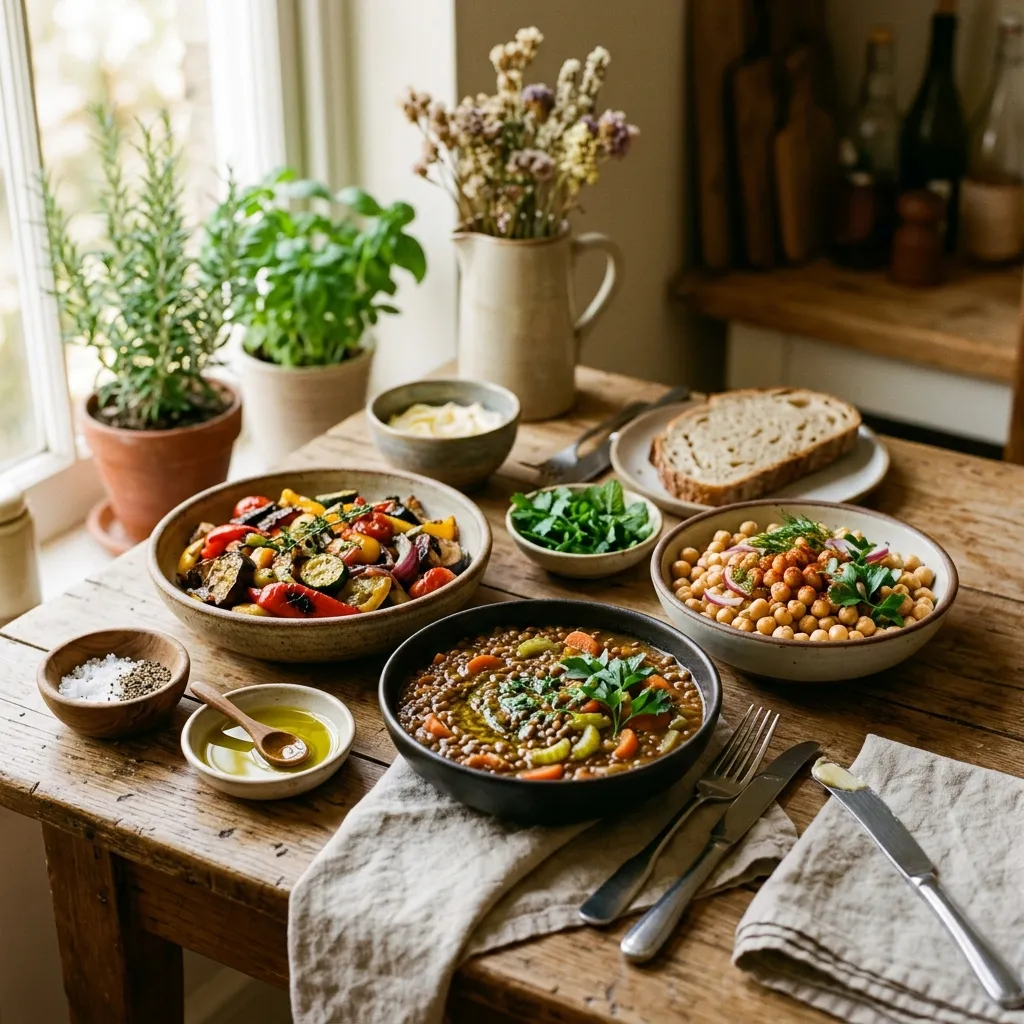
- Roasted Vegetables with Tahini Dip (35 min, 25 in oven): Mixed vegetables, olive oil, salt. Dip made from tahini, lemon, water. Kids arrange the vegetables on the sheet.
These and your own variations can be saved directly and used in the next meal plan.
These recipes work fresh, but what about the old ones the family has loved for years?
How Do You Keep Family Recipes When Your Diet Changes?
Family recipes don't have to disappear when kids eat vegetarian. Many classics can be rebuilt with one ingredient swap without losing their character. Grandma's goulash becomes mushroom goulash, ground beef casserole becomes a lentil version, meat gravy becomes mushroom gravy.
Two-column thinking helps: original on the left, vegetarian version on the right. Same recipe, different protein.
Eating is memory. The smell of paprika sauce on Sunday, the set table, the ritual. All of that stays, even in the vegetarian version. When you also write down and save the new variation, there's no loss—there's a second recipe in the family story. Digitizing recipe variations in an app saves time long-term and keeps both versions accessible for the next generation.
And that brings us back to the question from dinner: How do you cook for a family that's no longer the same? You don't rebuild. You adapt. Once you've understood that, what's left is just one next step: start. The FamFood app has weekly plans, recipe variations, and shopping lists ready so your first Monday isn't an experiment—it's a plan.
When you don't throw out the old but adapt it, you quickly notice: the biggest resistance doesn't come from the plate—it comes from the person sitting next to it.
Frequently Asked Questions
At What Age Can a Child Eat Vegetarian?
Lacto-ovo-vegetarian diet is basically possible at any age in principle, as long as nutrient coverage is right. The younger the child, the more important variety in protein sources and adequate calcium intake become. From school age on, kids can actively help plan what gets cooked, which makes it easier to carry out.
How Do I Explain to Grandparents That My Child Won't Eat Meat?
Short and calm: "They wanted to try it, so we're giving it a go." No long debates at family dinners. Bring a vegetarian dish that tastes good. That solves more resistance than any explanation. Grandparents who notice the food is delicious ask far fewer questions.
Does My Child Need B12 Supplements on a Vegetarian Diet?
With lacto-ovo-vegetarian diet (including eggs and dairy), B12 deficiency is rare but possible if the child barely eats these foods. A blood test from your pediatrician clarifies it in one checkup. A supplement doesn't hurt, but it's not automatically necessary.
How Do I Keep Track of Nutrients in a Vegetarian Family Diet?
Instead of analyzing every meal, the week-level view is enough: did we have legumes, dairy, eggs, leafy greens, and whole grains this week? If yes, supply is usually adequate. For a more structured approach, the FamFood app offers templates for balanced weekly plans.
What Do I Cook When Some Kids Want Meat and Others Don't?
The building block principle works here too. Cook the vegetables and side for everyone together, offer two proteins: one vegetarian and one with meat. Two pans, one effort. No separate cooking, no two completely different dishes.
About FamFood: We're a small team of parents, cooks, and tech nerds who believe family recipes shouldn't disappear in dusty notebooks. FamFood is the digital place where family meals stay together, even when the diet changes.