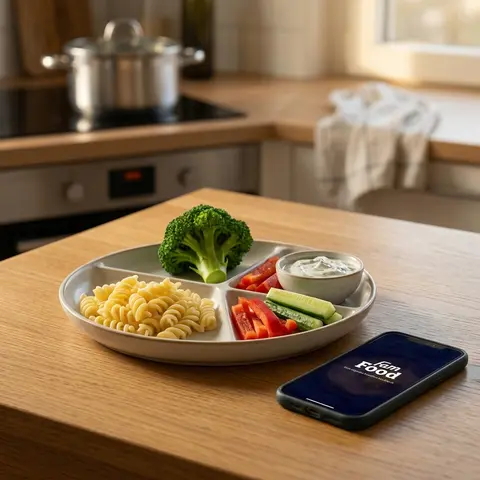
Vegetarian Meals for Mixed Households
Dad wants his schnitzel. The kids eat only pasta with butter. And you sit with a bowl of lentil soup, alone at the table.
This is exactly where most articles about vegetarian family cooking don't start. They assume everyone is convinced. That everyone's on board. That the family collectively decided to stop eating meat. That situation exists. It's just rare.
This article starts in reality: mixed household, different opinions, one table. What we observe in families using FamFood: resistance to vegetarian dishes drops dramatically the moment you stop talking about it and simply cook well.
The essentials
- Children need a new food offered 8 to 15 times before they accept it (BZfE, 2022)
- Iron, B12, zinc, and omega-3 are the four nutrients where vegetarian families develop the most gaps, according to the German Nutrition Society (DGE)
- Legumes cost about one-fifth the price of ground beef per serving of protein
- The best starting point isn't radical change, but one committed vegetarian evening per week
Does cooking vegetarian work when your family isn't convinced?
Yes. The secret isn't persuasion, it's quiet familiarity. Children need to encounter a new food 8 to 15 times before they accept it (BZfE, Children and Nutrition, 2022). When you introduce vegetarian dishes as additions rather than replacements—for instance, lentils in bolognese instead of meat—you sidestep dinner-table debates. It works. And it requires zero discussion about ethics or carbon footprint.
The "Trojan Horse" principle works like this: familiar structures stay, ingredients change quietly. Bolognese looks the same whether it contains ground beef or lentils, if the spices are right. Tacos satisfy just as much with kidney beans and corn as with meat, if the salsa is bold enough. Nobody needs to give a lecture. The food speaks for itself.
What fails reliably at dinnertime is convincing people through arguments. Raising points about ethics, environment, or health at the exact moment someone is hungry and eating doesn't work. Serve good food. Ask if it tastes good. This is the slower path. It's also the one that lasts.
Mixed households are the rule, not the exception. Once you accept that, you stop spending energy on debates and start spending it on good recipes.
Which nutrients families really need to watch during the transition
Iron, B12, zinc, and omega-3 are the four to focus on. For vegetarians who regularly eat dairy and eggs, B12 is usually not a problem. Iron absorption works best when you add vitamin C. A blood test after 6 to 12 months provides peace of mind without causing panic beforehand. If you understand these four points, you steer your family's nutrient intake with purpose, according to the German Nutrition Society (DGE), without deficiency.
Iron and vitamin C: the underrated pair
100g of cooked lentils provide around 3.3mg of iron, oats about 4.5mg per 100g. Pumpkin seeds deliver nearly 8mg per 100g. The catch: plant-based iron (non-heme iron) is absorbed worse than iron from meat. Vitamin C triples absorption rates. In practice: serve bell peppers, tomatoes, orange juice, or broccoli with the same meal.
B12, zinc, and omega-3: what you need to know
B12 is the only nutrient that vegans absolutely must supplement. For vegetarians who regularly eat dairy and eggs, it's usually not an issue. Zinc lives in pumpkin seeds, legumes, and cheese. Omega-3 comes from flaxseeds, chia seeds, and walnuts, although conversion to the active EPA/DHA form is limited. If you're unsure, a blood test from your doctor after 6 to 12 months of transition is worthwhile, but there's no reason to panic beforehand.
Nutrient | Good plant-based sources | Tip for absorption |
|---|---|---|
Iron | Lentils, oats, pumpkin seeds, tofu | Combine with a vitamin C source |
Vitamin B12 | Eggs, dairy products (vegetarian) | Supplement if eating vegan |
Zinc | Pumpkin seeds, legumes, cheese | Soaking legumes improves uptake |
Omega-3 | Flaxseeds, chia seeds, walnuts, canola oil | A small amount daily |
How do you build a vegetarian weekly kitchen that truly satisfies?
The most common mistake is simply removing meat without adding anything in its place. Satiation comes from protein and fat, not side dishes. Legumes, eggs, whole grains, and quality oils take on this role when you know how to use them. Pasta without sauce and bread without topping fill you for an hour. Lentils with olive oil and whole-grain bread keep you satisfied for four.
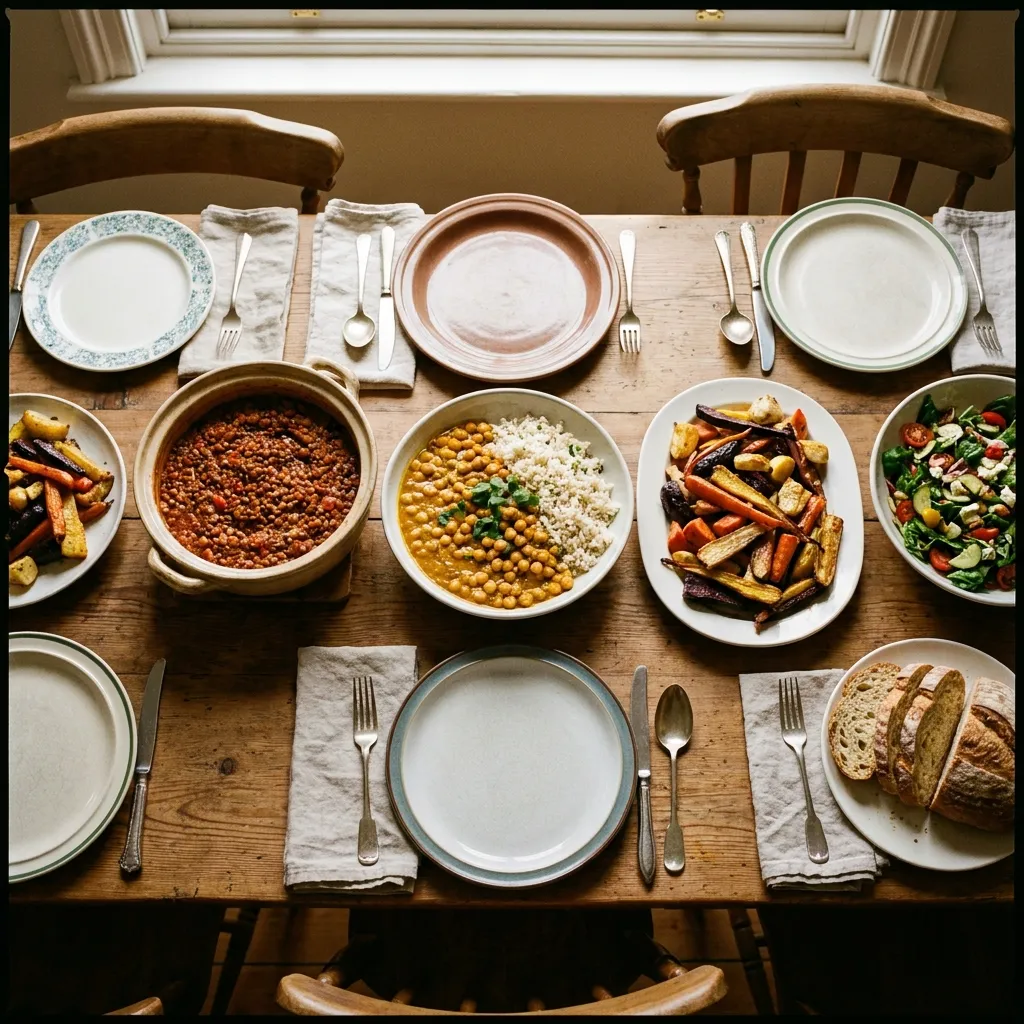
The "three-part rule" for every plate: protein plus complex carbohydrates plus good fat. Chickpea curry with brown rice and a splash of coconut milk. Scrambled eggs with whole-grain toast and avocado. Lentil stew with sourdough bread and canola oil. Once you internalize this pattern, you don't have to think through individual dishes.
Batch cooking simplifies the week considerably. One large pot of chickpeas on the weekend covers curry (Monday), hummus (Tuesday), salad topping (Wednesday), and soup (Thursday). Three rotating legumes instead of inventing new concepts daily.
What we observe in FamFood: among the most saved vegetarian recipes, 8 out of 10 have fewer than 7 ingredients. Simplicity isn't a compromise—it's why a recipe makes it to the table.
Monday through Friday: a realistic starter plan
Day | Main dish | Protein source | Prep time |
|---|---|---|---|
Monday | Lentil bolognese with pasta | Red lentils | 25 min |
Tuesday | Chickpea curry with rice | Chickpeas (precooked) | 20 min |
Wednesday | Shakshuka with bread | Eggs | 20 min |
Thursday | Vegetable fried rice | Eggs plus edamame | 15 min |
Friday | Vegetable quesadillas with cheese | Black beans plus cheese | 20 min |
For more meal planning inspiration, FamFood has you covered.
Kids and vegetarian food: why they refuse and what actually helps
Kids don't eat vegetarian because it's healthy. They eat it when it tastes good, looks familiar, and they somehow took part. That's not weakness—that's developmental psychology. Neophobia, resistance to new foods, is biologically normal in children between 2 and 8 years old. New textures are harder to accept than new flavors.
In many families using FamFood, we see the same pattern: resistance drops sharply when kids get to make a choice during shopping or cooking. Not "Eat this now," but "Do you want chickpeas or lentils today?" It's a small difference with big impact.
Dishes with unfamiliar, visible pieces—tofu cubes, large mushroom slices, unknown legumes—come to the table only once baseline acceptance exists. First, the Trojan Horses: lentils in the bolognese, carrots in the pancakes, spinach in the smoothie.
Dishes that work reliably: lentil bolognese (looks like the familiar version), vegetable quesadillas (finger food, crispy, cheesy), chickpea curry with rice (slightly sweet sauce, familiar structure). What these dishes share: known form, new filling.
The strongest lever is cooking together. Kids who dropped an ingredient into the pot themselves are more likely to taste it. It takes time but saves dinner-table arguments. Want to expand that? Having kids bake shows how structure turns potential chaos into a learning format.
Vegetarian and still budget-friendly: how much does a family really save?
A four-person family can save between 50 and 150 euros per month through mostly vegetarian eating, according to the German Consumer Association, depending on which animal products get replaced. Legumes cost about one-fifth the price of ground beef per serving of protein. That's not an approximation—that's supermarket reality.
Where vegetarian gets expensive: ready-made substitutes. Vegan schnitzel, plant-based ground meat alternatives, and ready-made veggie burgers often cost more than the meat they're meant to replace. They're practical for getting started but not a long-term solution.
Seasonal vegetables are the best cost reducer. Whatever's in season costs less and tastes better.
Protein source | Price per 100g protein (approx.) | Price for 4 servings (approx.) |
|---|---|---|
Ground beef | about 3.50 EUR | about 5.00 EUR |
Chicken breast | about 2.80 EUR | about 4.00 EUR |
Red lentils (dry) | about 0.60 EUR | about 0.90 EUR |
Chickpeas (canned) | about 0.70 EUR | about 1.00 EUR |
Tofu (plain) | about 1.40 EUR | about 2.20 EUR |
Eggs | about 1.00 EUR | about 1.50 EUR |
Shopping list for a vegetarian week starter under 30 euros: lentils (dry), chickpeas (canned), eggs, tofu, rice, oats, canned tomatoes, onions, garlic, frozen vegetables. With that as your base, you can cook five different dinners without shopping again.
Which vegetarian protein sources should your family know?
Legumes, eggs, dairy products, tofu, tempeh, seitan, and nuts: these are the seven main pillars. If you regularly rotate at least three of them, you'll meet current DGE protein recommendations without meat. The embarrassment of riches isn't the problem—not knowing what each thing is becomes the problem.
Product | Protein per 100g | Taste/texture | Good for beginners? |
|---|---|---|---|
Tofu (plain) | about 8g | Mild, absorbs flavors | Yes, well-marinated |
Tempeh | about 19g | Nutty, firm, slightly bitter | More for experienced cooks |
Seitan | about 25g | Meat-like, chewy | Yes, if gluten is fine |
Red lentils | about 9g (cooked) | Mild, creamy | Excellent |
Chickpeas | about 9g (cooked) | Nutty, firm | Excellent |
Eggs | about 13g | Familiar | Classic |
Cottage cheese | about 12g | Mild, creamy | Yes |
Legumes without bloating: how to make the transition work
A common stumbling block that most cooking blogs mention but never actually solve. The reason for bloating: legumes contain oligosaccharides that your body needs to learn to break down. The solution isn't magic—it's method.
Soak dried legumes for at least 12 hours, discard the soaking water, and use fresh water for cooking. Rinse canned legumes thoroughly. Increase portions slowly: twice in week one, then three times, then daily. Add spices that support digestion: cumin, fennel, ginger. After 2 to 3 weeks your gut adapts. For most people, discomfort disappears almost completely.
Tofu, tempeh, seitan: what's what?
Tofu is pressed from soy milk, has a mild flavor, and takes marinades beautifully. Tempeh is fermented soy, nuttier in taste, firmer in texture, and more nutritious. Seitan is made from wheat gluten, has a meat-like, chewy consistency, and is the most protein-rich option. For starting out, tofu makes sense because it's most versatile.
How does your family actually start cooking vegetarian?
The best approach isn't radical change but the "one evening per week" rule. If you cook vegetarian consistently on Mondays, you shift 52 meals per year. Without arguments. Without persuasion. Without backsliding. Meatless Monday isn't a trend—it's a low-friction anchor that works because it demands no big decision.
Three starter recipes that have proven themselves:
Lentil soup (4 servings, about 1.80 EUR protein cost): Sauté onions and garlic, simmer red lentils with canned tomatoes and vegetable broth, add cumin and paprika, finish with lemon juice. 25 minutes. Everyone's full.
Vegetable fried rice: Cooked rice from yesterday, frozen vegetables, eggs, soy sauce, sesame oil. 15 minutes. Kids often make this themselves if you let them.
Shakshuka: Simmer canned tomatoes with paprika and onions, crack eggs directly into the sauce, serve with bread. 20 minutes. Looks like an event, takes almost nothing.
Save favorite recipes before they vanish from memory. FamFood exists for exactly this. Store recipes once, find them again next week. No screenshot chaos, no lost scraps of paper.
Be realistic: it takes weeks before everyone joins in. Some partners try only after months. Some kids refuse even after the twelfth offer. That's normal. The goal isn't perfection—it's a direction.
Frequently asked questions about vegetarian family cooking
Can my child eat vegetarian without developing a deficiency?
Yes, according to the DGE, a well-planned vegetarian diet is suitable for children. Eggs and dairy products cover B12 and most other critical nutrients. What matters is variety: different protein sources daily, vitamin C combined with iron sources, and a blood test from your pediatrician after one year of eating this way.
Which vegetarian dishes do kids actually enjoy?
Lentil bolognese, vegetable quesadillas, chickpea curry with rice, vegetable pancakes, and scrambled eggs on toast. What these dishes share: familiar form, new filling, nothing visibly "unknown." Kids accept the familiar more easily, so keep the structure first, change ingredients gradually.
How do I introduce legumes without causing bloating?
Start with small amounts, increase portions over 2 to 3 weeks. Soak dried legumes for 12 hours and discard the soaking water. Rinse canned versions thoroughly. Add cumin, fennel, or ginger while cooking. After the adjustment period, your gut bacteria adapt, and bloating decreases significantly for most people.
Is vegetarian food really cheaper than meat dishes?
Usually yes, if you focus on legumes and seasonal vegetables. Ready-made substitutes (vegan ground meat, plant-based schnitzel) often cost more than meat. Red lentils cost about 0.60 euros per serving of protein, ground beef about 3.50 euros. According to the German Consumer Association, a four-person family can save up to 150 euros monthly.
How do I convince my partner to try eating vegetarian?
Don't—at least not through arguments while eating. Cook a dish so well it speaks for itself. Start with the familiar: bolognese, tacos, curry. Make no demands, don't make it an issue. Once someone's enjoyed a dish twice, they'll eventually ask what was in it.
About FamFood
FamFood is a digital family recipe keeper for people who cook without the drama. We understand everyday life with mixed eating preferences, tight schedules, and kids who loved carrots yesterday. What we share, we've tested in our own kitchens.