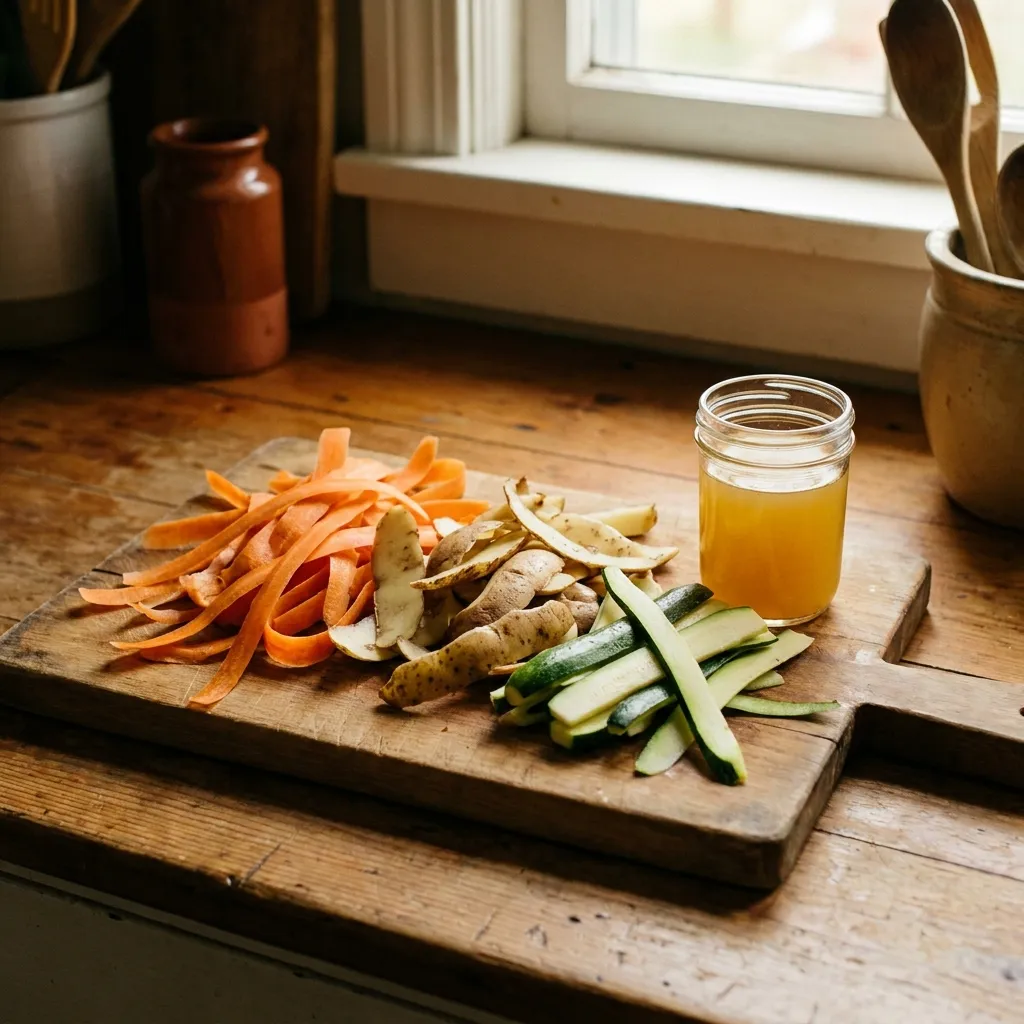
There it sits. The potato peel on your cutting board, half peeled off, crooked and a little earthy. Your hand is already reaching for the trash. Wait.
What's lying there is ready to cook. Not sort of, but really: You could make broth right now, bake chips, or use it to boost tomorrow's soup. It costs zero dollars. No extra shopping list needed. And kids find it surprisingly cool when something that "should be thrown away" suddenly lands on the table.
You'll discover which peels are edible and how to turn them into something delicious in under 30 minutes.
Key Takeaways
- Most vegetable peels (potato, carrot, zucchini) are edible or perfect for broth, as long as the veg is organic or thoroughly washed.
- According to the German Federal Ministry of Food and Agriculture (BMEL), German households throw away around 6.5 million tons of food annually, with a large portion being avoidable scraps like peels.
- A freezer-bag collection system makes peel use low-pressure: freeze peels until you have enough for a batch of broth.
- Kids aged 6+ can participate actively. Based on feedback from FamFood families, this increases their willingness to actually eat the result.
Which Vegetable Peels Can You Actually Eat?
Most vegetable peels tossed in German kitchens daily are edible, as long as the veg is organic or well-washed. This includes potato, carrot, zucchini, beet, and squash peels, plus onion skins, which are perfect for broth and stock. Toxic or inedible are eggplant skins in large amounts (contains solanin), green potato spots, and moldy or mechanically damaged peels.
Peel | Directly Edible | Broth/Stock Only | Notes |
|---|---|---|---|
Potato | ✓ (organic, remove green) | ✓ | Always remove green spots |
Carrot | ✓ | ✓ | Quick brush is enough |
Zucchini | ✓ | ✓ | Very thin, great raw or sautéed |
Squash (Hokkaido) | ✓ | ✓ | Skin softens when cooked |
Beet | ✓ | ✓ | Stains heavily, gloves recommended |
Onion | ✗ | ✓ | Gives broth color and depth |
Avocado | ✗ | ✗ | Bitter, contains persin |
Moldy | ✗ | ✗ | Always discard |
Organic or Conventional: When Is the Peel Safe?
With organic veg, the peel is almost always safe and can go straight into your pot raw or for broth. Conventional produce should be scrubbed thoroughly under running water before eating the skin, since pesticide residue concentrates in the outer layer. For broth, conventional peels work fine because volatile residue is mostly removed when you strain the cooking water. The German Center for Nutrition (BZfE) recommends scrubbing, not just rinsing.
According to the German Federal Statistical Office (Destatis), Germany generates millions of tons of food waste annually in home kitchens, with a large share from kitchen and vegetable waste. Vegetable peels land in compost bins disproportionately often, even though many could be reused directly.
Why Do Vegetable Peels End Up in the Trash So Often?
According to the German Federal Ministry of Food and Agriculture (BMEL), German households throw away around 6.5 million tons of food annually. A large portion of that is avoidable waste like peels, stems, and leaves. The main reason isn't lack of motivation, but missing concrete recipe ideas.
What we see regularly among FamFood users: potato and carrot peels land almost reflexively in the bin, even as the person pulls a stock cube packet from the cupboard at the same time. The peel counts as "waste" out of pure habit. No rational judgment behind it, just an automatic pattern ingrained since childhood.
Here's the key: the moment families learn a concrete method, a freezer bag, a recipe, a how-to, behavior changes. Recipes without a plan land in the trash. Recipes with a system land in the pot.
How Do You Make Vegetable Broth from Peels in 30 Minutes?
In FamFood tests, we found: robust vegetable broth from collected peels, stems, and roots needs exactly four ingredients and 30 minutes of cooking. The result replaces any stock cube packet and costs literally nothing, since those scraps would've hit the bin otherwise. From about 200 g of mixed peels you get roughly 700 ml of rich broth. Collect more, you get more; the ratio stays stable.
What you need: Collected peels (about 200 g), 1.5 liters water, salt, optional bay leaf and peppercorns.
Step by step:
- Tip peels from the freezer bag straight into the pot, no thawing needed.
- Cover with cold water, bring to a boil, then simmer 25 minutes on medium heat.
- Strain through a fine sieve, season lightly with salt.
- Pour into jars or ice-cube trays.
Broth keeps 5 days in the fridge. Frozen, it stays good for up to 3 months.
Which Peels Add Flavor, Which Add Bitterness?
Carrot, parsnip, and celery peels deliver the most umami and sweetness. Onion skins color the broth golden-brown and bring depth. Use sparingly: cruciferous peels (broccoli, Brussels sprouts) can turn bitter with long cooking. Potato peels are neutral and bulk up the volume nicely. Tip: never more than one-third cruciferous peels in your total mix.
Crispy Vegetable-Peel Chips: Does This Actually Work?
Yes, but only with the right temperature. Potato and carrot peels get crispy at 400°F / 200°C (fan) in 15 to 20 minutes if you pat them dry first and brush them lightly with oil. Too much oil makes them soggy instead of crispy. That's the most common mistake we see: in our tests, families used about three times too much oil on average because they read "light brush" as "generous coat." Half a teaspoon of oil for a handful of peels is plenty.
How to prep them:
- Spread peels in a single layer on a baking sheet, never stacked.
- Pat dry with paper towels, then oil.
- Season: Parmesan and garlic for older kids, paprika salt for younger ones, Herbes de Provence for grown-ups.
Kids aged 6+ can pat the peels dry and season them themselves. That makes them a co-creator, not a spectator.
Oven Chips vs. Air Fryer: What's Worth It for Families?
Method | Temperature | Time | Result | Best For |
|---|---|---|---|---|
Oven (fan) | 400°F / 200°C | 15-20 min | Evenly crispy | Large batches, multiple trays |
Air Fryer | 375°F / 190°C | 8-12 min | Very crispy, slightly drier | Small portions, quick fix |
Oven (conventional) | 410°F / 210°C | 20-25 min | Less even | Only if no fan available |
According to GfK market research, air fryers have spread rapidly in German households since 2022. If you have one, peel chips are a win: shorter time, less oil, instant result. But for families with big appetites, the oven pays off because you can make more at once.
What Other Ideas Are There for Using Vegetable Peels?
Beyond broth and chips, there are three more ideas that actually work in daily family cooking: mashed potato-peel soup base, zucchini-peel strips in stir-fries, and roasted squash peels as a topping. All three take less than 20 minutes and need no extra shopping.
Mashed potato-peel base: Instead of peeling potatoes, just scrub thoroughly and cook with the skin on. Then mash. The result is rustier, slightly nutty, and you skip the peeling step entirely. Works best with waxy potato varieties.
Zucchini peels as a zoodle stand-in: Peel zucchini lengthwise, cut the peels into long strips, and sauté 2 minutes in a pan with a little olive oil. Works as a light side or pasta add-in, no spiralizer needed.
Roasted squash peels as a topping: Break Hokkaido peels into chunks, toss with salt and olive oil, into the oven. 20 minutes at 400°F / 200°C. The result tastes great as a crispy garnish over soup or salad. You'll find the right seasonal squash window in the FamFood seasonal guide.
For nights under 30 minutes, mashed peel base is the fastest option because it skips a step rather than adding one.
How Do You Store Peels Until You Need Them?
The simplest way: a freezer bag in your freezer. Collect peels over several days and freeze them until you have enough for a batch of broth. No time pressure, and peels stay usable for up to three months.
How the collection system works:
- What goes together: Potato, carrot, celery, parsnip, zucchini.
- What should be collected separately: Onion peels in their own bag, because their smell transfers to other peels.
- Cruciferous peels label best as "Broth max 1/3" so you don't accidentally use too much later.
For short-term use within 2 days, the fridge is fine. Important: rinse peels briefly and pat dry with paper towels before freezing. Wet peels freeze together and are harder to portion later.
You can set up a recipe note in FamFood titled "Peel Stash" and log what's currently in your bag. That way, next time you cook, you'll instantly know if you've collected enough for a batch.
How Do You Get Kids Involved in Using Vegetable Peels?
Kids who help with using scraps eat the result much more willingly because they've invested their own work. Seasoning chips, straining broth, patting peels dry: these are tasks elementary-school kids can handle.
Age | Task |
|---|---|
From 4 | Put peels in the freezer bag, mix seasonings |
From 6 | Pat peels dry, season chips, pour broth through strainer (with help) |
From 9 | Independently prep and season chips, measure and pour broth |
One idea that works in several FamFood families: introduce a "weekly peel collector." That child watches to make sure peels go into the right bag while cooking. Small, concrete, repeatable.
This kind of involvement teaches something about food appreciation on the side, without a single sustainability lecture. For families wanting an even easier entry point, our piece on using broccoli stems offers a good first step for younger kids.
Frequently Asked Questions About Using Vegetable Peels
Can You Eat Vegetable Peels Raw?
Yes, with certain types. Zucchini peels, carrot peels, and cucumber peels are edible raw and taste good sliced thin in salads or as a snack with dip. Potato peels should always be cooked, since raw potato starch is hard to digest and green spots contain solanin.
Which Vegetable Peels Are Toxic or Inedible?
Green or sprouted potato peels contain solanin and belong in the trash. Avocado peels are bitter and contain persin, which is toxic to animals. Rhubarb peels have high oxalic acid and shouldn't be eaten. Moldy peels of any kind go directly out.
How Long Can You Keep Vegetable Peels in the Fridge?
Maximum 2 days in a sealed container or zip bag. After that, they lose flavor and texture. For longer storage, freezing is best: peels stay good for up to 3 months without quality loss.
Do I Have to Peel Vegetables Before Cooking for Kids?
No, with organic veg it's usually not needed. Hokkaido squash, zucchini, and carrots can cook with their skins on. With conventional produce, the BZfE recommends thorough scrubbing under running water. For very young kids (under 1), when in doubt, peel.
What Do I Do with Onion Peels?
Don't eat onion peels directly, but they're perfect for broth: they add depth and a nice golden color. Collect separately because their smell transfers to other peels. Use about 2–3 onion-peel halves per 1.5 liters of water in broth. More than that can make the broth bitter.
About FamFood: We're a team of parents, cooks, and tech enthusiasts making family cooking actually work on a busy day. What's here comes from real kitchens with real kids, not from a textbook. FamFood is the app where your family recipes stay safe and don't vanish into a chat history somewhere.