Which Knife for What: The Right Tool at the Right Moment
Most families own five to eight knives. And grab the same one every day. Not because the others are useless, but because no one ever explained when each one actually makes sense. This post changes that. Not with a product list, but with one simple question: Which knife are you reaching for right now?
Key Takeaways
- Two knives handle 80% of everyday family cooking: an 8-inch chef's knife and a 3-4 inch paring knife.
- The serrated bread knife is the only specialty knife that almost every family uses daily.
- A sharp knife is safer than a dull one, even for children.
- The dishwasher, glass cutting boards, and cluttered drawers are the three biggest knife killers.
- One good chef's knife (€30-60) beats any cheap ten-piece set.
What knives do you actually need before you start cutting?
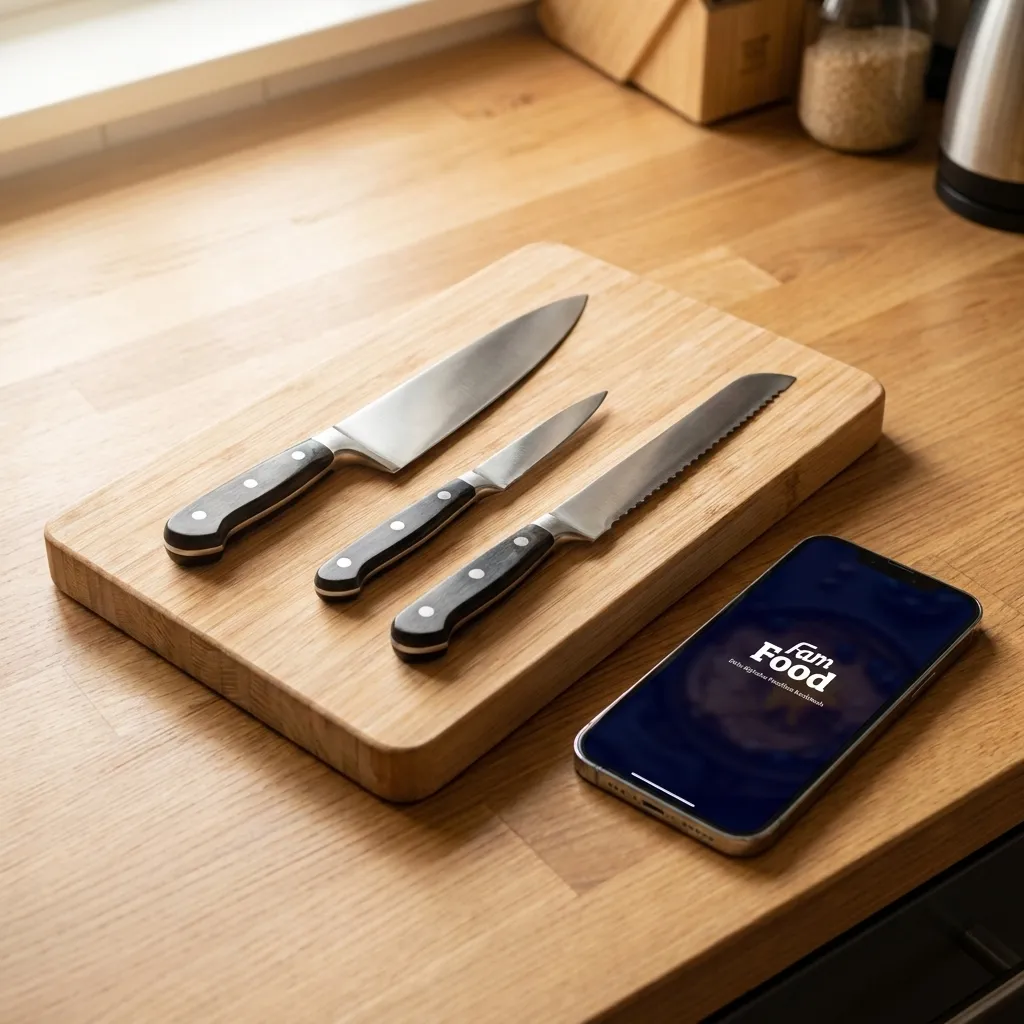
For 80% of everyday kitchen tasks, two knives are enough: an 8-inch chef's knife and a 3-4 inch paring knife. Everything else is specialty equipment for specific situations, not standard gear. Once you internalize this, you'll stop reaching blindly into the knife block.
The decision rule is simple: Is the item smaller than your hand? Use the paring knife. Larger, fibrous, or voluminous? Chef's knife. This rule works reliably for carrots, onions, meat, herbs, and most everyday vegetables without requiring a second thought.
What stands out in FamFood user surveys: households with one well-sharpened chef's knife and a small paring knife prep meals faster on average than households with a full knife block, where only the front two knives ever get pulled out. The block itself creates the illusion of choice where none is needed.
Chef's knife, santoku, or utility knife: What's the difference?
The European chef's knife with its curved blade works better for rocking cuts and breaking down large vegetables; the Japanese santoku with its straighter blade excels at thin, uniform slices. For family cooking, this difference only becomes noticeable once you've developed some kitchen skill. For beginners, a good chef's knife is the safe choice.
Blade geometry in three sentences: The chef's knife has a curve that lets you keep the tip on the board and rock the blade. The santoku is ground flatter, which enables more precise push cuts. The hollow edge found on many santokus (small indentations along the blade surface) prevents thin slices from sticking.
The utility knife splits the difference: shorter than a chef's knife, longer than a paring knife, 5-6 inches. Who should buy one? Households with limited counter space or people with smaller hands who find an 8-inch chef's knife unwieldy. For everyone else, it's a compromise that does both moderately well.
Stiftung Warentest tested kitchen knives across different price ranges and found that inexpensive knives come dull from the factory, but can reach comparable sharpness to premium models after professional sharpening.
Chef's knife: strengths and everyday tasks
Task | Chef's Knife | Santoku | Utility Knife |
|---|---|---|---|
Dicing onions | ✓ Excellent | ✓ Good | ✓ Good |
Mincing herbs | ✓ Excellent | ○ Limited | ○ Limited |
Slicing carrots | ✓ Good | ✓ Excellent | ✓ Good |
Portioning meat | ✓ Excellent | ✓ Good | ○ Limited |
Small fruit pieces | ○ Oversized | ○ Oversized | ✓ Good |
Santoku: When the Japanese blade wins
The santoku shines whenever precision matters: uniform cucumber slices for a bento box, thin fennel matchsticks for a salad, fine vegetable brunoise. If you cook a lot of Asian food or care about uniform presentation, you'll quickly appreciate the flatter grind. If you mainly cook soups and stews, you won't need it.
Bread knife, fillet knife, cheese knife: When is specialty equipment worth it?
The serrated bread knife is the only specialty knife that almost every family actually uses daily, because no smooth blade can cut soft bread cleanly without squashing it. Fillet knives and cheese knives are genuine specialty tools that only pay off if you use them regularly. Cook fish once a month? Your chef's knife will do fine.
The serrated edge of a bread knife grips the surface and saws through the crust without transferring pressure to the soft crumb. That's exactly what a smooth blade cannot do. At the same time, it's unsuitable for vegetables and meat because it tears rather than cuts. The bread knife stays in bread territory.
Knife Type | Daily Need | Who Uses It? | Skippable For |
|---|---|---|---|
Bread knife (serrated) | High | Almost all families | Families without bread consumption |
Fillet knife (flexible, thin) | Low | Fish lovers, 2x/week+ | Occasional fish eaters |
Hard cheese knife | Medium | Cheese lovers, large blocks | Those who buy sliced cheese |
Soft cheese knife | Low | Brie/Camembert fans | Everyone else |
Nakiri (vegetable knife) | Low | Ambitious vegetable cooking | Beginners and families |
Kitchen knives for kids: What's the right choice here?
For children under 8, nylon-blade knives with serrated edges work well, like Opinel's children's line or Kuhn Rikon. These cut soft vegetables and fruit but pose no danger from sharp metal. From age 8-10 on, a small, properly sharp paring knife in the right grip size may actually be safer than a dull large knife.
Dull is not safe. That's the most important sentence in this section. A dull knife slips because it needs more force. A sharp children's knife in the right size cuts with minimal pressure and stays on the food. The German Federal Ministry of Food and Agriculture recommends cooking as active learning for children from preschool age, which includes proper tool handling.
Grip size is the deciding factor, even more than sharpness or material. A knife too large for the hand cannot be controlled. For more details on age-appropriate recommendations, check the FamFood article Knives for Kids: When Is Each Blade Safe?.
How sharp does a knife really need to be, and how can you tell?
A sharp knife cuts through newspaper cleanly without tearing and glides through a tomato without you applying pressure. According to estimates from the tool-sharpening trade, most German household knives go at least 12 months without sharpening when they're in regular use. The result is kitchen equipment that requires more force and causes more accidents.
The paper test: Hold a sheet of newspaper in the air and draw the knife through the top edge. Clean cut? Sharp. Torn? Time to sharpen. The tomato test: Lay the blade on the tomato skin without pressure. Does it glide through? Good. Do you have to press? Not sharp enough.
What the Professional Association for Raw Materials and Chemical Industry (BG RCI) documents for commercial kitchens applies at home too: dull knives are involved in a high proportion of cutting accidents because they slip.
Using a honing steel correctly: the 3-step technique
The honing steel realigns the blade but doesn't remove material. Step 1: Place the steel upright on your cutting board. Step 2: Set the blade at a 15-20 degree angle. Step 3: Draw it from base to tip with light pressure along the steel, alternating both sides, 5-8 passes per side. Once a week is enough for a daily-use chef's knife.
Sharpening stone for beginners: what matters?
A combination stone with 1000/3000 grit is sufficient for home use. Soak the stone, hold the knife at a 15-20 degree angle, draw evenly from base to tip, 10-15 strokes per side. Once or twice a year is enough for a well-honed knife. Unsure? Many kitchen specialty shops offer affordable sharpening services.
What destroys a good knife faster than anything else?
The dishwasher, glass cutting boards, and poor storage in cluttered drawers are the three biggest knife killers in family kitchens. All three can be avoided with minimal daily adjustments, requiring no effort or money.
The dishwasher is the biggest culprit. Alkaline detergent and high temperatures cause blades to oxidize, dull polished steel, and attack sharpness. One cycle often isn't enough to cause visible damage, but after 20 wash cycles the blade is duller and more rust-prone than necessary.
ÖKO-TEST tested cutting boards made from different materials. The result: glass is simply counterproductive as a cutting surface because the hard surface dulls the edge with every cut. Wood and plastic are the right alternatives.
Knife Killer | Damage | Alternative |
|---|---|---|
Dishwasher | Blade oxidizes, sharpness breaks | Hand wash with warm water |
Glass cutting board | Edge dulls with every cut | Wood or plastic board |
Unprotected drawer | Blades rub together, dull | Magnetic strip or blade guard |
Left wet | Rust, especially carbon steel | Dry immediately |
Wrong sharpening (too steep angle) | Edge chips | Maintain 15-20 degree angle |
The magnetic strip is the most space-saving, knife-friendly storage option. Knife blocks are the practical alternative for families with children, since blades are hidden. A drawer without protection is only acceptable if each knife has a blade cover.
Which knife to buy: What really matters in your choice?
For family cooking, one quality steel chef's knife with 58-60 HRC hardness (Rockwell scale) beats any ten-piece budget set. According to Stiftung Warentest, good value falls in the €30-60 range for a solid German or Japanese entry-level knife.
The two most important purchase criteria: steel hardness (58+ HRC holds sharpness longer) and blade length (8 inches for adults, 6-7 inches for smaller hands). Everything else is secondary.
German brands like Wüsthof, Güde, and Zwilling manufacture with durability and re-sharpening in mind. Japanese entry-level lines like Kai Wasabi or Global Ukon often ship with superior sharpness but are more sensitive to lateral stress. Buying a set promises completeness and usually delivers four knives you'll never touch. Buy one good knife instead, care for it, and add strategically. It's more sustainable and far cheaper in the long run.
With FamFood, you collect not just recipes but also see directly which prep steps need which tools. That turns knife selection from a puzzle into part of a practiced kitchen routine. Find more practical kitchen tips in the article Kitchen Hacks: 10 Tips That Save Your Day.
Common questions about kitchen knives
Which knife is most versatile for family cooking?
The European chef's knife with an 8-inch blade is the most versatile tool in family cooking. It handles rocking, chopping, dicing, and carving. Combined with a paring knife (3-4 inches), it covers roughly 80% of everyday cutting tasks without needing additional knives.
Can I put knives in the dishwasher?
No. Alkaline detergent, high temperatures, and rubbing against other utensils damage the blade, grind, and handle. Quality knives should always be hand-washed with warm water and mild soap, then dried immediately. Even budget knives last significantly longer this way.
How often should I sharpen my kitchen knife?
Use a honing steel every second or third use to maintain sharpness in daily cooking. A sharpening stone makes sense once or twice a year to remove material and re-form the cutting edge. If you cook daily, you'll need the stone more often than someone who cooks two to three times a week.
What's the difference between a honing steel and a sharpening stone?
The honing steel realigns the microscopically bent edge without removing much material. It maintains sharpness but doesn't restore it. The sharpening stone deliberately removes steel and reforms the cutting edge. For a completely dull knife, only the sharpening stone works; the honing steel alone won't be enough.
How do I know if a knife is truly sharp?
Two quick tests: Draw the blade through a sheet of newspaper held upright. Does it cut cleanly? Sharp. Lay the knife on a tomato without pressure. Does the blade glide right through the skin? Sharp. Does it need pressure, more pressing than cutting? Time to sharpen. The tomato test always works without tools.
About FamFood: We're a team of home cooks, parents, and food enthusiasts who help families make kitchen life simpler and more relaxed. Our tool is the FamFood app, our drive is the conviction that good food needn't be complicated.