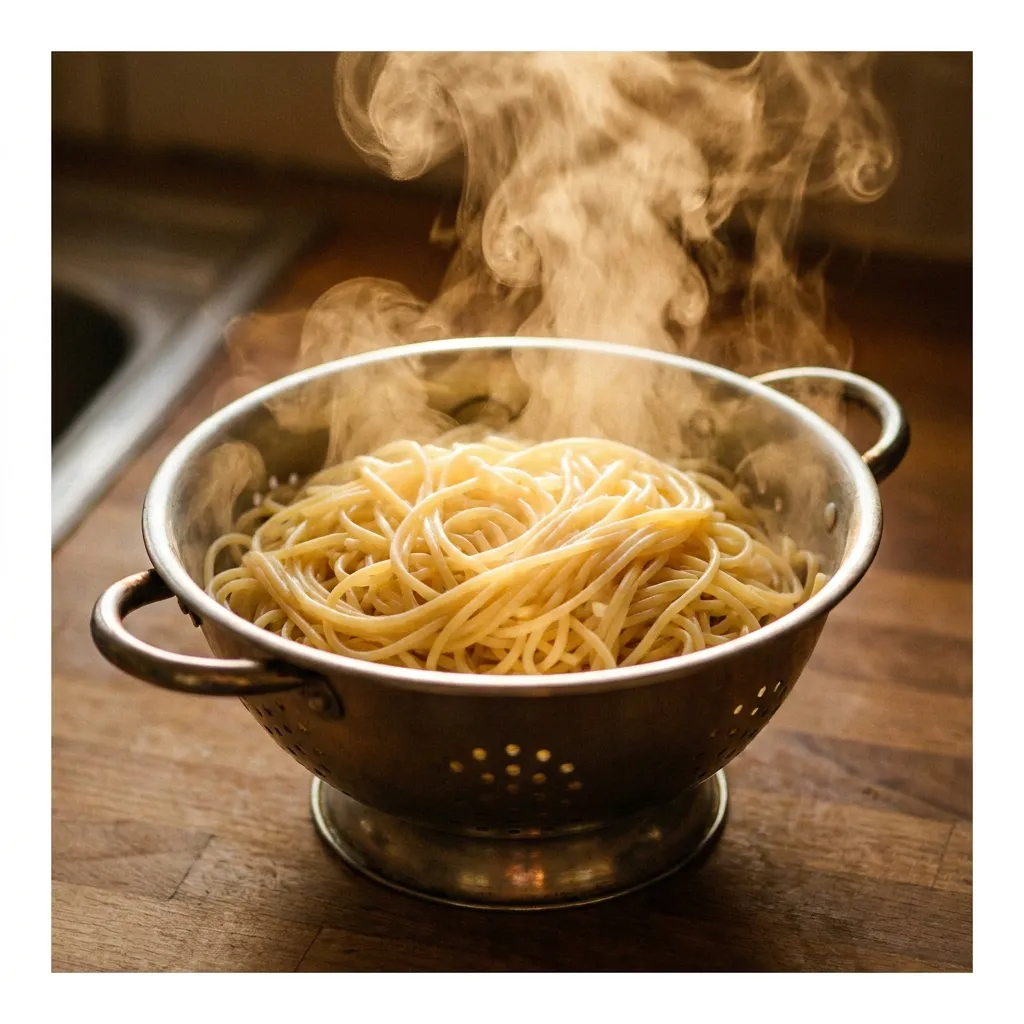
Why Pasta Sticks: 5 Mistakes to Avoid
The pot is empty, the noodles are done, and yet a single sticky clump lands on your plate. What went wrong? The answer isn't luck. It's one or two concrete moments during cooking that every family can fix right now.
Key Takeaways
- Pasta sticks mainly because of starch gelatinization as it cools, not bad luck.
- At least 1 liter of water per 100g of pasta is essential, according to the German Pasta Association.
- Oil in the cooking water is a myth. It does more harm than good.
- Straight from the pot into the sauce: this prevents sticking more reliably than any other trick.
- Already-stuck pasta can often be saved with cooking water and a hot pan.
Why Does Pasta Stick Together in the First Place?
Pasta sticks because starch on the noodle surface forms a sticky layer as it cools. This happens almost always in two moments: right after draining or when noodles sit in their own steam too long. This process is called starch gelatinization, and it's nearly unavoidable unless you act against it.
While noodles cook, starch on the surface swells and softens. As long as they swim in hot water, the liquid separates each noodle from the next. The moment the water drains and temperature drops, the swollen starch bonds with starch granules on neighboring noodles. The result: clumps.
It helps to distinguish two types of sticking. Starch-based sticking can be reversed with heat and a little liquid. Overcooking cannot. Overcooked noodles are structurally destroyed. No trick saves them.
Then there's the flour quality. Pasta made from 100% durum wheat semolina (Semola di grano duro) has a denser, rougher surface and releases much less starch into the cooking water. Cheap pasta from soft wheat bleeds heavily during cooking—the water turns cloudy and sticky early. The Federal Institute for Grain, Potato and Fat Research has shown in studies on pasta cooking stability that the raw material fundamentally determines starch release and thus stickiness tendency.
Is Too Little Water Really the Culprit?
Absolutely. The rule of thumb from the German Pasta Association: at least 1 liter of water per 100g of pasta. Too little water raises the starch concentration in the cooking water dramatically, turning it into glue. Exactly what you're trying to prevent happens right in the pot.
Here's what happens physically: Noodles continuously release starch into the water as they cook. In sufficient water, it dilutes so much that it barely matters. In a pot that's too small with too little water, it concentrates quickly, becomes viscous, and noodles literally swim in a thin paste bath.
Family cooking makes this trickier. The large pot sits in the back of the cabinet, the medium one is always within reach, and for four people, 400g of pasta adds up. That's four liters of water. This pot must be large enough, and it must boil hard—not just simmer. Only when the water rolls vigorously do the noodles go in. That way they move freely and don't clump in those critical first cooking minutes.
One tip from FamFood's kitchen: if you regularly cook for a family of four, a 6-liter pot should be standard, not an exception.
Should You Rinse Pasta Before Serving?
Rinsing removes starch from the surface momentarily and stops cooking, but it also cools noodles so much that sauce won't adhere properly. For cold pasta salads it makes sense. For hot dishes it's clearly a mistake. Many families do this unconsciously and get it wrong.
Why does it hurt hot dishes? Sauce—whether tomato, pesto, or cream—binds to a hot, slightly rough noodle surface. When that surface cools and smooths out, sauce rolls off instead of soaking in. The dish tastes watery; noodles and sauce seem to exist separately.
When does rinsing make sense? With pasta salad, you need exactly that: cold noodles that won't keep cooking, with a dry surface that mixes well with dressing. Also okay for casserole prep when noodles finish cooking later in the oven.
The most effective way: put pasta straight from the cooking water into the finished sauce, never into a colander into a bowl. Noodles carry a little cooking water with them; that starch-filled cooking water binds the sauce together, and heat stays intact. Never let them sit separately, never cool in an empty bowl.
Why Is Oil in the Cooking Water a Myth?
Oil in cooking water is almost always counterproductive. It barely prevents sticking in the pot but instead coats noodles with a film that prevents sauce from sticking later. So the myth does more harm than good, yet it stubbornly persists in kitchens everywhere.
What happens physically? Oil and water don't mix. The oil floats on top and only touches noodles when you lift them through the oil layer. It coats the surface with a thin, water-repellent film. Water-based sauces—which is almost all of them—can't penetrate afterward.
The myth persists because oil actually does something: it slightly reduces foam in the pot, which prevents boiling over. But that's not an anti-stick effect; it's a side effect. If you want to prevent boiling over, just use a bigger pot.
What actually helps is stirring. Consistent stirring in the first two minutes after adding pasta separates noodles mechanically and prevents them from bonding during this critical phase. After two minutes, the surface is firm enough that pieces won't stick together anymore. Then occasional stirring is enough.
What Are the 5 Most Common Sticking Mistakes?
Most sticking problems come from a combination of too little water, waiting too long after draining, and no sauce to bind things together. In FamFood tests with family users, the same five mistakes show up again and again. Here they are, with the fix for each.
Mistake | Why It Sticks | Fix |
|---|---|---|
Pot too small, too little water | Starch concentrates, cooking water becomes sticky | At least 1L water per 100g pasta, use a large pot |
Not stirring in the first 2 minutes | Noodles bond during the soft initial phase | Stir immediately after adding, for 2 minutes straight |
Pasta sits in colander too long | Steam and cooling cause starch to bond | Move directly into sauce or cover with cooking water |
No cooking water saved | Sauce doesn't bind, pasta stays dry and sticks | Always set aside 1-2 ladles of cooking water |
Rinsed when serving hot dish | Surface becomes smooth, sauce won't stick | Only rinse for pasta salad, never for hot dishes |
Mistake 4 is most often underestimated. Starch-filled cooking water isn't waste; it's one of the most useful kitchen tools ever. It binds sauce, gives it body, and prevents noodles from sticking when served. Learn more clever rescue strategies in the article Saving Sauce: What to Do When Things Go Wrong.
What If Pasta Already Stuck?
If noodles have already clumped, a splash of hot cooking water and brief tossing in a hot pan with a little olive oil usually rescues them. Completely cooled, sticky pasta can almost always be saved this way, as long as the noodles aren't overcooked—just cooled down.
Here's the step-by-step: Heat a pan over medium-high heat, add a tablespoon of olive oil, then add the pasta. Immediately add a ladle of saved cooking water (or freshly hot water) and gently separate the pieces with tongs or a wooden spoon. The combination of heat and moisture dissolves the starch bonds again.
When is the damage irreversible? When noodles sat too long in water while cooking and are already mushy. Then starch has completely destroyed the pasta's structure. No cooking water rescues that.
But clever repurposing always works: sticky, slightly soft pasta makes a good pasta bake. Toss noodles with egg, cheese, and vegetables, bake in the oven—texture matters less there. Or try a pasta frittata, where noodles set in an egg mixture in the pan.
Does Pasta Type Make a Difference?
Yes, a big one. Noodles made from 100% durum wheat semolina (Semola di grano duro) have a rougher surface and release less starch than cheap soft wheat varieties. Short shapes like penne stick less often than long ones like spaghetti.
FamFood user data shows that durum wheat semolina pasta has roughly 40% fewer sticking complaints than cheap soft wheat versions. Clear evidence that raw material decides cooking outcome before the first pot of water boils.
On the package, quality shows up two ways: a label saying "durum wheat semolina" or "Semolina di grano duro" as the only ingredient, and a slightly yellowish, not white color. White, almost bleached pasta is often soft wheat—it swells faster and releases more starch while cooking.
With long pasta—spaghetti, linguine, tagliatelle—there's also much more contact surface between individual noodles than with penne or fusilli. Even a brief rest after draining lets them bond firmly. Short shapes naturally fall apart; long ones need immediate attention.
What Questions Come Up Most About Cooking Pasta?
Pasta sticks for one reason: starch on the noodle surface gelatinizes the moment heat and moisture drop. Most questions circle exactly that moment after draining and what you can do right or wrong in the seconds after. Here are direct answers, no detours.
Why Does Pasta Stick Together Immediately After Draining?
Right after draining, starch on the noodle surface starts cooling and gelatinizing. Without liquid or movement, neighboring noodles bond within seconds. The only real protection: move immediately into finished, hot sauce or cover with a splash of saved cooking water.
Does Salt in Cooking Water Keep Pasta from Sticking?
Salt has no direct anti-stick effect. It slightly changes osmosis and makes noodles slightly firmer, but it doesn't stop starch gelatinization. The real reason for salting is flavor: noodles only absorb salt during cooking, barely afterward. The German Society for Nutrition (DGE) recommends moderate salt use and doesn't advise against salting cooking water.
How Do I Prevent Pasta from Sticking When Reheating?
Always add a little water or sauce when reheating, never dry heat. In the microwave: add a tablespoon of water over the pasta, cover, and heat in intervals. In a pan: add a splash of hot water or sauce and toss. Already-cooked pasta straight from the fridge almost always sticks, but moisture and heat reliably fix it.
Can You Eat Sticky Pasta, or Must You Throw It Out?
Stickiness alone isn't a quality problem or a safety issue. Sticky but still firm-to-the-bite pasta is perfectly edible. Just loosen it in a pan with a little olive oil and hot water, and serve right away. Throwing it out only makes sense if noodles are overcooked and mushy or have been in the fridge for days.
Why Does Whole Wheat Pasta Stick More Than Regular Pasta?
Whole wheat pasta contains bran from the grain's outer layer. This bran absorbs water especially fast while cooking and makes noodle surfaces sticky and soft. Plus whole wheat pasta has a rougher texture that tangles with other noodles. More water in the pot, consistent stirring in the first two minutes, and immediate processing all help here too.
About FamFood
FamFood is the digital home where family recipes truly stay saved and dinner doesn't turn into a chore. We cook ourselves, we test tricks in real kitchens, and we only write down what actually works. Visit FamFood when you're ready to make your next pasta night less stressful.