Why Does Rice Get Mushy? 6 Mistakes & Fixes
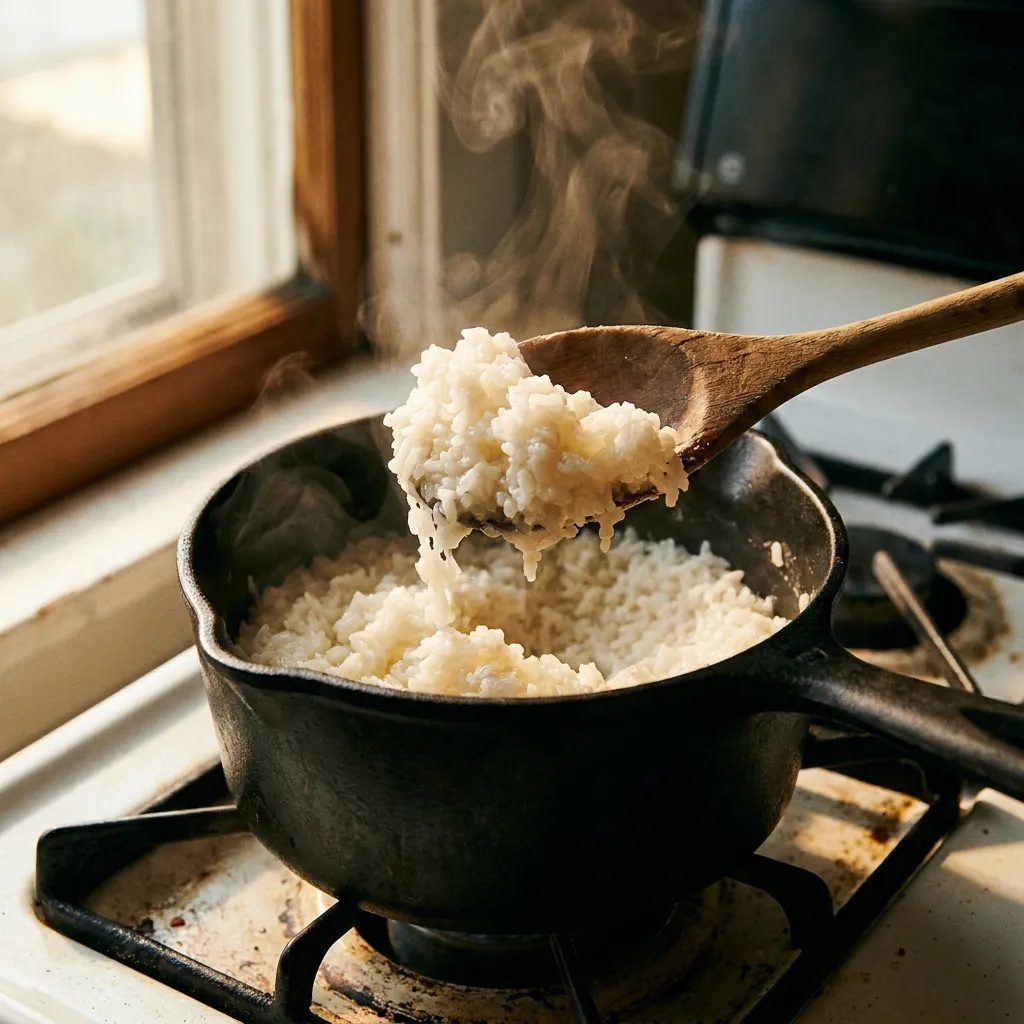
The pot just came off the heat. You lift the lid. And instead of fluffy, fragrant grains, a sticky mush stares back at you.
Frustrating? Absolutely. But it's not an accident. Mushy rice always has a clear cause. Usually the same one. This post explains what really happens in the pot, why the mistake almost always starts with the water ratio, and how to get it right from the beginning next time.
Key Takeaways
- Rice gets mushy when too much water, too much heat, or too long cooking causes starch granules to burst.
- The most common problem is a wrong water-to-rice ratio, usually too much water.
- Rinsing helps basmati and long-grain rice, but it's counterproductive for risotto rice.
- Mushy rice isn't trash: rice fritters or rice soup are quick rescue ideas.
Why Does Rice Get Mushy in the First Place?
Rice turns mushy when starch granules inside the grain absorb too much water and burst. This happens through three main factors: too much water, too much heat, or cooking too long. All other mistakes that follow in this post are variations of these three.
Rice grains are roughly 80 percent starch. When heated, this starch binds water and swells—a process food technologists call starch gelatinization. As long as this happens in a controlled way, you get the desired tender bite. But when the process spirals out of control because too much water is present or the heat stays too strong for too long, the starch molecules burst and fuse into a porridge-like mass. The Max Rubner Institute, Germany's federal food research center, describes this gelatinization as temperature-dependent: starch begins binding water as early as 60 °C.
The most common single mistake, by the way, is the wrong water-to-rice ratio—too much water. If you fix just this one point, you solve most of your mushy-rice problems. Pour too generously or ignore the variety, and you're fighting physics that can't be undone.
What Water-to-Rice Ratio Works for Which Type?
The most common problem is a water-to-rice ratio that's too high. For normal long-grain rice, use 1:1.5 (rice to water); for basmati, closer to 1:1.25. If you pour by feel, you almost always pour too much, because the fear of burnt rice instinctively pushes you toward more water. Germany's Federal Ministry of Food and Agriculture (BMEL) recommends a much smaller amount of water for common rice varieties than most package instructions claim.
Package instructions are often unreliable. Manufacturers calculate generously so the rice cooks safely regardless of pot size or stove type. In everyday cooking, though, this leads to water overkill, especially on induction cooktops, which regulate heat more precisely and intensely.
A simple everyday hack: measure rice and water with the same cup. That way the ratio stays exact no matter how much you're making, and you don't need a scale.
Rice Type | Rice : Water | Cooking Time (Low Heat) | Special Note |
|---|---|---|---|
Long-grain | 1 : 1.5 | 10–12 min | Versatile, robust with heat |
Basmati | 1 : 1.25 | 8–10 min | Fragrant, swells significantly |
Risotto rice (Arborio) | Broth as needed | 18–22 min, stirring | Starch is desired, no fixed ratio |
Risotto rice is a special case: starch is released intentionally through constant stirring, not a mistake but a method. For all other varieties, the opposite holds true.
Why Do I Need to Stop Stirring While Cooking Rice?
Stirring while cooking releases surface starch and glues the grains together. One stir right after it comes to a boil is enough. Then lid on, hands off.
Here's the physics: friction between the spoon and grains loosens starch from the grain surface. This starch goes straight into the hot water and forms a sticky matrix around the grains. Every additional stir reinforces this effect.
That's why a rice cooker works so well: it never stirs. Water boils through, steam distributes evenly, and a thermostat shuts off once the liquid is absorbed. You can apply this exact logic to a pot on the stove.
The concrete action: stir once, when the water boils and the rice goes in. Close the lid. Don't open it again until the timer rings. No peeking, no taste-testing, no "just a quick stir."
How Do I Prevent Heat and Cooking Time from Ruining the Rice?
Too much heat boils water into the grain too fast; too long cooking gives the grains no chance to hold their structure. The rule of thumb: bring to a boil, then reduce to the lowest setting, lid on, timer set.
The two-phase method works reliably: In phase one, bring water and rice together at high heat—it takes about two minutes to reach a boil. In phase two, immediately drop to the lowest setting: 10 to 12 minutes for long-grain, 8 to 10 minutes for basmati.
Induction cooktops are trickier than gas stoves. Induction regulates energy very slowly when turning down: if you switch from level 9 to level 2, the plate stays at high power for a few seconds longer. That's enough to drive way too much water into the grain in a flash. Stiftung Warentest, Germany's consumer testing authority, found in tests that induction cooktops need up to 30 seconds to actually throttle back power after a level reduction. Tip for induction: after it boils, jump straight to level 1, or use a second, already-cool cooktop.
The five-minute rest after turning off the heat is often skipped, even though it's crucial. Rice that goes straight from the stove to the plate is cooked on the outside but still damp and under pressure inside. The resting phase lets the remaining steam distribute evenly through all the grains and prevents the bottom from staying mushy while the surface dries out.
Does Rinsing Rice Really Make a Difference?
Yes, but only for certain types and goals. Rinsing rice before cooking removes surface starch that would otherwise stick immediately. For basmati and long-grain rice, it's recommended; for risotto or rice pudding, it's counterproductive because starch is explicitly desired there.
Food science shows that rinsing can remove up to 30 percent of surface starch (BZfE, the German Federal Food and Nutrition Institute). That sounds minor, but it makes a noticeable difference when cooking: grains stick less to each other and stay fluffier.
The practice is simple: put rice in a sieve, rinse under cold running water, move it gently with your hand, and repeat. After two or three passes, the water runs clear. The whole thing takes about a minute.
Rice Type | Rinsing Recommended? | Reason |
|---|---|---|
Basmati | Yes | Reduce surface starch, grains fluffier |
Long-grain | Yes | Stickiness prevention |
Jasmine | Yes | Slight stickiness desired, but rinsing helps |
Risotto rice (Arborio) | No | Starch is the desired part of creaminess |
Rice pudding rice | No | Binding needs the starch |
Sushi rice | No | Stickiness is the goal |
Can I Still Rescue Mushy Rice?
Once mushy, the grain structure can't be fully restored. But mushy rice isn't trash. It works wonderfully for rice porridge, rice fritters, or as a thickener in soups.
A quick fix works partially with slightly overcooked rice: spread it thin on a baking sheet and bake it for 10 minutes at 150 °C. The dry heat removes excess moisture. It won't be perfect, but it noticeably improves the texture.
If the rice is really too far gone, keep cooking it. Rice fritters made from mushy rice, an egg, and a bit of Parmesan—fried golden brown on both sides in a pan—are the fastest leftover dinner you can imagine. Or stir the rice into vegetable broth and simmer it into a creamy soup.
When is rice truly past saving? If it develops a sour or musty smell, or the color shifts grayish, then it goes to the compost. Texture alone is not a discard criterion. Smell is.
For more ideas on what you can make with leftover rice, check out Creative Ways to Use Leftovers: 9 Ideas That Actually Work.
The Mistake Checklist: What to Do Next Time
Six concrete points you check before you turn the stove on bring your mushy-rice rate down to nearly zero. No magic, just consistency.
- Identify the type. Long-grain, basmati, or specialty? The ratio depends on it.
- Measure the ratio. Use a cup, don't guess. Rice to water: 1:1.5 (long-grain) or 1:1.25 (basmati).
- Rinse once. For basmati and long-grain, cold running water until it runs clear.
- Bring to a boil, then reduce immediately. High heat to start, lowest setting for the rest.
- Don't stir. After the first stir when you add the rice: lid closed, timer on.
- Let it rest for 5 minutes. Heat off, lid on, wait. Only then open it.
Our app data shows: in 7 out of 10 homes that give us feedback through FamFood, step 6 is the first one skipped because hunger wins. The result is a wet bottom and dry top—the opposite mushy problem. Give yourself those five minutes. They're worth it.
You can save this checklist directly in the FamFood app and pull it up the next time you cook rice.
Frequently Asked Questions
Why does my rice stick together even though I use little water?
Stickiness despite little water usually comes from stirring too often. Every stir releases surface starch that glues the grains. Too much continuous heat can create the same effect, even if the water ratio is right. Stir once after it boils, then lid on and don't touch it.
What happens if I start rice with very cold tap water?
Cold tap water changes the cooking time because the pot takes longer to reach a boil. During this extended heating phase, the rice already absorbs water without the starch gelatinizing evenly. If you start with cold water, shorten the total cooking time by 1 to 2 minutes and be extra careful about the water ratio.
Can I cook rice in salt water without it getting mushier?
Yes. Salt affects flavor, not texture, as long as the amount is moderate. Half a teaspoon per 200 g of rice doesn't noticeably change the cooking profile. Much more salt can minimally affect starch structure, but that's not a problem in everyday cooking. Add salt to the cold water before you bring it to a boil.
Why doesn't rice get mushy in a rice cooker but does in a pot?
A rice cooker never stirs, works at a consistently low temperature just below boiling, and automatically switches off once the water is absorbed. In a pot, heat varies more, the lid gets opened, and you often stir multiple times. All of this releases extra starch and prolongs cooking time uncontrollably. If you apply rice-cooker logic to a pot—stir once, lid on, timer set—you'll get very close to the same result.
Can I rescue mushy rice somehow?
You won't get the original grain structure back. But mushy rice works well for further cooking: dry it on a baking sheet at 150 °C for 10 minutes (if only slightly overcooked), turn it into rice fritters with egg and cheese, or stir it into soups. If it smells unpleasantly sour, throw it out.
About FamFood: We're a team of parents, home cooks, and food enthusiasts with a simple idea: family cooking should bring joy, not stress. Everything we write, we've tried ourselves first—at our own stove, with real kids, and real hunger.