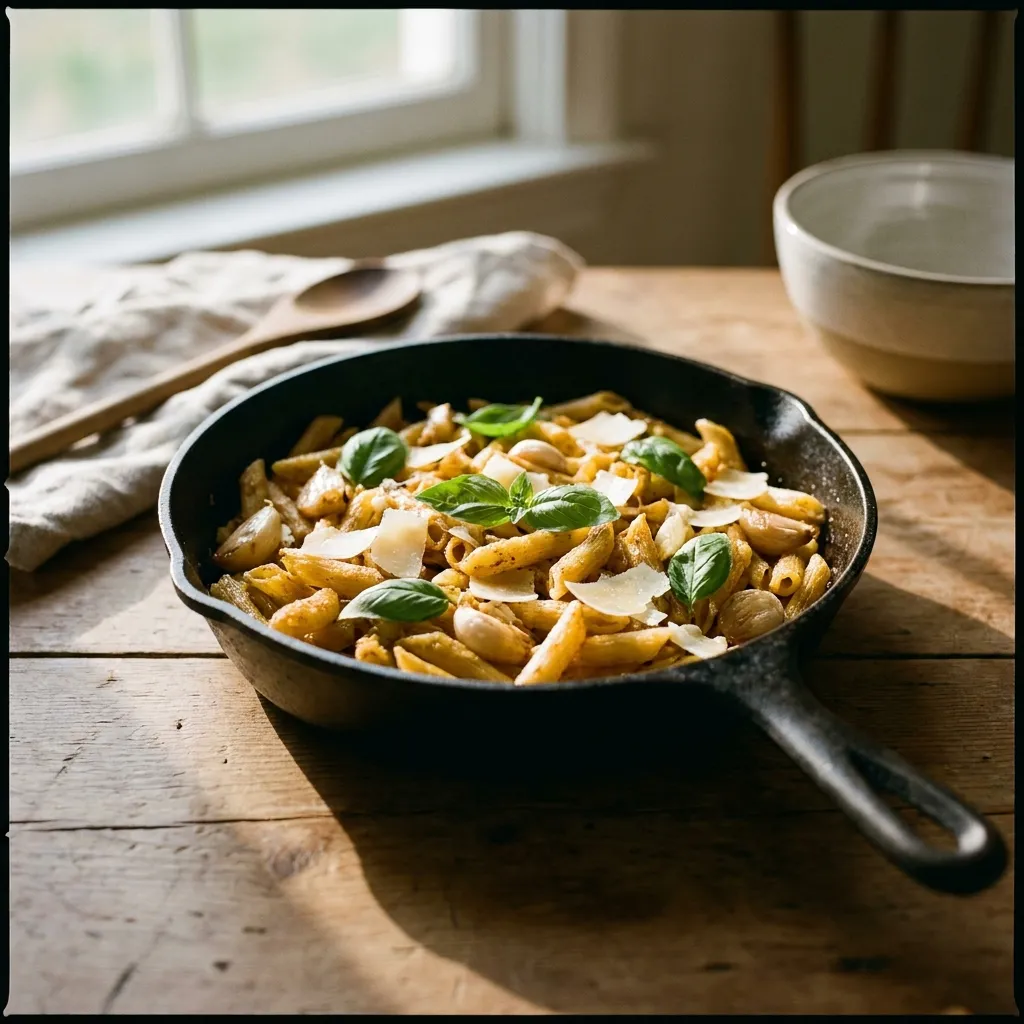
Mushy, sticky, somehow sad. That's how most people imagine yesterday's pasta. Except the exact opposite is true: under the right conditions, yesterday's pasta often tastes more intense than freshly cooked pasta. The sauce has had time to soak into the noodle. The flavors have settled. What was a solid dinner yesterday can become a really good lunch today.
You don't need to cook like a professional chef for this. You just need a few basic rules and five minutes.
Key Takeaways
- Yesterday's pasta tastes more intense because the sauce seeps into the starch structure overnight (retrogradation).
- Storing noodles and sauce separately keeps leftovers fresh for up to 3 days.
- According to the German Federal Ministry of Food and Agriculture, the average German household throws away roughly 78 kg of food annually. Pasta is one of the easiest categories to save.
- With 5 recipe ideas and the right reheating method, leftover pasta becomes a complete meal.
Why does yesterday's pasta sometimes taste even better?
Cooked pasta absorbs sauce more deeply as it cools. The starch undergoes retrogradation, which means the starch molecules rearrange themselves as they cool, the noodle's structure becomes slightly denser, and flavors seep in. This isn't a kitchen myth, it's food chemistry.
When you leave Bolognese or tomato sauce in the fridge overnight, exactly this happens: the noodle soaks it up. The result is denser, more flavorful, more filling. Pesto works differently because olive oil solidifies in the cold and the sauce doesn't blend as evenly. Here, reheating in a pan with a splash of olive oil is worth the effort.
Creamy sauces like carbonara or mushroom cream are the most sensitive: they can separate when reheated or become rubbery if too much heat is used. But here too: low temperature, a little liquid, stir slowly, and it works.
What we hear again and again in the FamFood community: most people reheat their pasta leftovers wrong, namely without liquid, on high heat, without a lid. The result is predictable. Once someone tries the right method, they never do it differently again.
How do you store yesterday's pasta correctly?
Store pasta and sauce separately in airtight containers in the fridge; they'll keep for up to 3 days. Already-mixed pasta dries out or becomes sticky because the sauce pulls moisture from the noodle.
Before storing, stir a small splash of olive oil into the noodles. This prevents them from sticking together and makes later pan-frying easier.
Sauce Type | Store Separately? | Fridge Shelf Life | Freezing? |
|---|---|---|---|
Tomato sauce (Bolognese, Arrabbiata) | Yes, recommended | Up to 3 days | Yes, very good |
Pesto | Optional | Up to 2 days | Limited |
Cream sauce (Carbonara, Mushroom Cream) | Yes, essential | Up to 2 days | Conditional |
Oil-based (Aglio e Olio) | No, together is fine | Up to 3 days | Yes |
Refrigerator: up to 3 days
Store pasta in the fridge at no more than 4 °C. Cover open bowls with plastic wrap, or better yet, use a container with a lid. Cooked noodles without sauce easily keep 3 days; mixed pasta, depending on the sauce, more like 2 days.
Freezer: up to 2 months
Pasta freezes well, best in portions in freezer bags or containers. Tomato sauces freeze without issue. Creamy sauces can lose consistency when thawed. After thawing in the fridge (not on the counter), reheat slowly in a pan.
The 5 quickest recipes for yesterday's pasta
With 5 minutes of effort, yesterday's pasta becomes a complete meal. No need to warm it in a pot, no boredom on the plate. The best leftover dishes usually come from whatever's still in the fridge.
Dish | Ingredients (besides pasta) | Time |
|---|---|---|
Pasta Frittata | 2-3 eggs, cheese, salt | approx. 10 min. |
Garlic Pan Pasta | Garlic, olive oil, Parmesan | approx. 7 min. |
Cold Pasta Salad | Vegetables, vinegar, oil, herbs | approx. 5 min. |
Pasta Soup | Vegetable broth, soup vegetables | approx. 15 min. |
Pasta Bake | Cheese, leftover vegetables, optional sauce | approx. 20 min. |
Quick (under 10 minutes)
Pasta Frittata: Put leftover noodles in an oven-safe pan, pour 2-3 beaten eggs over them, grated cheese on top. Let set over medium heat, done. Kids love this format because you can cut the frittata like pizza.
Garlic Pan Pasta: Sauté garlic in olive oil, add the cold pasta straight to the pan, toss for 2-3 minutes. Parmesan on top, done. Minimal effort, big result.
Cold Pasta Salad: Mix pasta straight from the fridge with diced vegetables, a good splash of vinegar and oil, fresh herbs. Perfect for the lunchbox, keeps for another half day.
With a bit more time (10-20 minutes)
Pasta Soup: Bring vegetable broth to a boil, add any vegetables from the fridge, after 5 minutes stir in the finished pasta. Let it steep briefly. Simple and kids like it too.
Pasta Bake: Layer pasta in a baking dish, mix with leftover vegetables and a little sauce, cheese on top, bake at 200 °C for about 15 minutes. Anyone looking for creative leftover ideas for the whole family will find ready-made leftover plans in the FamFood app for exactly these situations.
How do you reheat pasta correctly without ruining it?
Most people make the biggest mistake in the microwave: heating pasta without liquid makes it rubbery. A splash of water or sauce, covered, makes the crucial difference between good and failed leftover food.
Method | Steps | Best for Sauce Types | Result |
|---|---|---|---|
Microwave | Cover, add 1-2 tbsp water/sauce, medium power, 1-2 min. | Tomato, Bolognese | Fast, adequate |
Pan | Medium heat, olive oil or butter, toss 3-5 min. | All, especially pesto | Best texture |
Oven | 180 °C, covered, 10-15 min. | Bake, cream sauce | Even, slow |
The pan is almost always the best choice. Olive oil or a small piece of butter over medium heat, pasta straight in, toss for 3-4 minutes. This creates light brown spots that give the pasta a new dimension. For cream sauces: low temperature, never let it boil, or the sauce will break.
The microwave works well as a backup if you cover it and add liquid. Without both, pasta becomes dry and tough.
Using pasta leftovers with kids: how to do it without drama?
Kids eat leftovers more easily when they've helped make them. Simple rule: make leftovers visible, let kids choose one ingredient, done. Frame leftovers as "secret ingredients" instead of "what's left over" and you'll get much less resistance.
Pasta frittata is the perfect kid-cooking format. Crack eggs, grate cheese, everything in the pan, watch it set. This works for kids around age 5 and up, is visually satisfying, and tastes reliably good.
Cold pasta salads with simple, familiar ingredients work great for lunchboxes: corn, cucumber, cheese cubes. No exotic extras, no surprises. Then the leftovers actually end up in bellies instead of the trash.
The 4-ingredient rule for kids using leftovers works with pasta too: noodles count as the base, kids choose at most three more ingredients. This limits overwhelm and gives them the feeling they decided.
Leftovers don't have to be a dirty word. They're an opportunity to show kids that cooking isn't a linear process, but one that keeps thinking about what's already there.
Which pasta shapes work best for leftover cooking?
Short, ridged shapes like rigatoni, penne, or fusilli hold flavors better than spaghetti and are ideal for pan-frying or baking. The ridges hold sauce even after reheating; smooth long noodles release it quickly.
Pasta Shape | Good for Pan-Frying | Good for Baking | Good for Salad |
|---|---|---|---|
Rigatoni, Penne, Fusilli | Excellent | Excellent | Good |
Spaghetti, Linguine | Good | Conditional | Good |
Farfalle, Orecchiette | Good | Good | Excellent |
Fresh Pasta (Tagliatelle) | Not ideal | Not ideal | Not recommended |
Whole Wheat Pasta | Good | Good | Excellent |
Fresh pasta doesn't reheat as well. It becomes mushy quickly and loses texture. Dried pasta from the supermarket is clearly superior for leftover cooking.
Whole wheat pasta changes texture somewhat more when cooling and reheating, but stays firm if you didn't overcook it. In salads it's especially good because it holds sauce longer.
How much pasta do you actually save by consistently using leftovers?
According to the German Federal Ministry of Food and Agriculture, the average German household throws away roughly 78 kg of food per year. Pasta leftovers make up a surprisingly large share and are among the easiest categories to save.
If you use leftover pasta three times a week instead of throwing it away, that adds up to roughly 15 kg of food saved per year. At an average price of around 1.50 euros per portion, that's about 115 euros a year. Not dramatically much, but a habit that builds.
Pasta is the ideal entry category for leftover cooking: it keeps well, is versatile, and takes minimal effort. Once you start here, you almost automatically develop leftover thinking for other foods. Find more ideas for how to waste less with minimal effort in the article Creative Leftover Ideas: 9 That Actually Work.
Frequently Asked Questions
Can you still eat yesterday's pasta?
Absolutely. Cooked pasta keeps in the fridge at below 4 °C for up to 3 days. The important thing is that it's stored in a closed container and reaches a core temperature of 70 °C when reheated. If it smells or tastes off, better throw it out.
How long does cooked pasta keep in the fridge?
Up to 3 days if stored in an airtight container. Pasta with cream sauce keeps shorter, about 1-2 days. Pasta without sauce keeps longest. If you want to be safe, label the container with the date.
Can you freeze pasta and use it later?
Yes. Pasta freezes well, best in portions and without sauce. Tomato sauces freeze without issue. Creamy sauces can lose consistency when thawed. Thaw in the fridge and reheat slowly in a pan.
What can I make with leftover pasta?
The quickest options: pasta frittata with eggs and cheese, garlic pan pasta, cold pasta salad for the lunchbox, pasta soup with vegetable broth, or a baked pasta gratin. All dishes are ready in under 20 minutes.
Why does reheated pasta become hard or sticky?
Pasta becomes hard when reheated without liquid at too high heat. It becomes sticky when too much moisture is added or it sits too long. The solution: always add a small splash of water or sauce, reheat at medium temperature, and cover if using the microwave.
About FamFood
FamFood is the digital place where family recipes don't get lost and leftovers get a second chance. We cook ourselves, test ideas with real families, and write about what actually works in everyday life. No glossy cooking, no perfection pressure. Just dishes that make it to the table.




